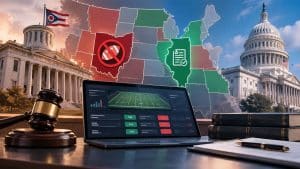
The fight over who controls America’s fastest-evolving wagering products has entered a decisive new phase. Kalshi’s courtroom victory in New Jersey is not just a win for one company; it is a test of whether the next era of event-based speculation will be governed as gambling, finance, or something uncomfortably in between.
A Decision That Could Change The Market
I see this ruling as one of the most consequential legal developments in U.S. betting this year because it strikes at the core regulatory question that has been hovering over the industry: when does a wager stop being a sportsbook bet and start becoming a federally supervised financial contract? In a split decision, the U.S. Court of Appeals for the Third Circuit concluded that New Jersey cannot block Kalshi from offering sports-related event contracts in the state, because those products fall within the jurisdiction of the Commodity Futures Trading Commission.
That distinction may sound technical, but its commercial implications are enormous. If sports event contracts are treated as swaps or derivatives rather than conventional gambling products, state gaming regulators could lose substantial authority over a category that looks, feels, and functions a lot like sports betting to ordinary consumers. That is the real significance of this case: it is not merely about one platform’s access to one state, but about the legal architecture of a growing national market.

Why Kalshi’s Model Has Become So Controversial
Kalshi operates in a regulatory gray zone that has become increasingly difficult for states to ignore. Its platform allows users to trade contracts tied to real-world outcomes, including sports results, through a framework approved at the federal level. Supporters argue that this makes the business fundamentally different from a sportsbook, because the contracts exist within a derivatives regime policed by a federal commodities regulator rather than by state gambling commissions.
Critics see something much simpler: consumers risking money on the outcome of sporting events. That is why state regulators have pushed back so aggressively. From their perspective, allowing a federally licensed exchange to offer sports-linked contracts inside state borders threatens to bypass carefully built sports betting systems, licensing requirements, tax structures, and consumer protection rules. The New Jersey case became such an important battleground precisely because the state is one of the most influential regulated sports wagering markets in the country.
For anyone trying to understand the legal backdrop, the prediction markets debate sits inside a larger argument over the reach of the Commodity Exchange Act and the CFTC’s role in supervising event contracts. That debate has now moved well beyond theory.
The Federal-State Clash Is Only Getting Bigger
What makes this ruling especially important is that it does not stand alone. I view it as part of a widening federal-state confrontation over who gets the final word on event-based contracts tied to sports, politics, and other public outcomes. In recent days, federal authorities have also moved against state efforts in Arizona, Connecticut, and Illinois, reinforcing the position that these contracts fall under exclusive federal oversight rather than a patchwork of state gambling laws.
That shift raises the stakes for everyone involved. If appellate courts continue to accept the federal preemption argument, states may find themselves unable to block certain prediction-style offerings even when those products closely resemble wagers already regulated under local sports betting laws. If courts reject that theory elsewhere, the industry could be left with a fragmented map where legality changes from one jurisdiction to the next.
This is why the New Jersey ruling matters beyond its immediate holding. It is the first major appellate signal that the CFTC-centered framework may have real staying power. That does not settle the issue nationally, but it gives operators a stronger legal foundation and encourages more aggressive expansion strategies.
What This Means For Sports Betting Operators
Traditional sportsbooks should be paying close attention. I do not think the immediate impact is that prediction platforms suddenly replace established betting operators. The more immediate pressure point is structural: platforms operating under federal rules may be able to enter conversations, markets, and product categories that sportsbooks can only access through expensive state-by-state licensing systems.
That creates a competitive imbalance the industry cannot ignore. A sportsbook operator faces taxes, integrity rules, local licensing obligations, advertising restrictions, and compliance burdens that vary across dozens of jurisdictions. A federally regulated event-contract venue could argue that it answers to a different and narrower regulator, with a different statutory mandate. If that model survives broader judicial scrutiny, the economics of market entry could change dramatically.
There is also a branding issue at work. Sports betting in the United States has spent years normalizing itself through state regulation, official league partnerships, and responsible gaming frameworks. Prediction markets arrive with a different narrative: they present themselves as financial exchanges, price-discovery tools, or information markets. That framing may appeal to policymakers in some contexts, but it also invites fresh questions about manipulation, insider information, and whether consumer safeguards are keeping pace.
The Legal Win Does Not End The Debate
It would be a mistake to read this decision as the end of the story. The court’s ruling strengthens Kalshi’s position, but it also sharpens the lines of conflict. One judge dissented in the New Jersey case, underscoring how unsettled the legal theory remains. Other states are still contesting similar offerings, and not every recent outcome has broken in Kalshi’s favor.
That matters because the issue is now too large to remain a niche dispute between regulators and a single exchange. It touches sports betting, derivatives law, consumer protection, federalism, and the future commercial value of event-based trading itself. The more money that flows into these products, the more likely it becomes that courts, Congress, and regulators will be forced to define the category with greater precision.
Why This Matters Right Now
I believe this ruling is a genuine inflection point because it exposes how unstable the current boundary has become between regulated gambling and federally supervised event trading. For years, that boundary held largely because prediction markets remained small, novel, and peripheral. Now they are large enough to threaten established regulatory systems and profitable enough to attract sustained legal and political attention.
Kalshi’s win in New Jersey matters right now because it gives real momentum to the idea that sports-related event contracts can operate outside the traditional state betting model. If that position continues to gain traction, the U.S. may be heading toward a two-track wagering system: one built on state gambling law, and another built on federal commodities oversight. That is no longer a speculative possibility. It is a live legal transformation already reshaping the future of American betting.