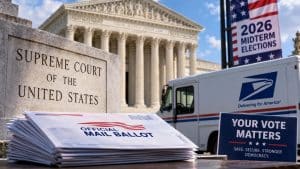
The Supreme Court mail ballot ruling has removed one immediate source of uncertainty from the 2026 midterms: the Postal Service cannot enforce the Trump administration’s new ballot-mail rule while litigation continues. The decision does not settle every legal question, but it means states can keep using existing mail-ballot systems as voting activity expands.
That makes the case important beyond election law. For readers following political risk, court intervention and campaign volatility around the best U.S. betting sites, the ruling tests how much procedural change the election system can absorb once ballots are already moving.
Supreme Court Mail Ballot Ruling Freezes a Late Rule Change
The Court denied the administration’s emergency request to lift a lower-court injunction blocking the Postal Service rule. The majority said the government was unlikely to succeed in challenging that injunction, while Justices Samuel Alito and Clarence Thomas publicly dissented. Justice Brett Kavanaugh agreed the rule should not take effect for the 2026 midterms, while suggesting the Postal Service could have a stronger authority argument in a future case.
That distinction matters. The ruling on the emergency request did not create a final judgment on every question raised by the policy. It left the lower-court block in place for this election cycle while the underlying litigation continues.
The practical result is immediate. Election officials can keep operating under established procedures rather than attempting a nationwide change weeks before November.
Operational continuity won out for now, even though the legal fight is not finished.
Trump’s Order Tried to Put New Federal Rules Into Ballot Mail
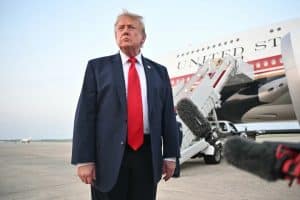
The dispute traces back to the March 2025 election order signed by President Donald Trump. The administration argued that stronger federal standards were needed to protect election integrity and tighten how mail ballots move through the postal system.
The later Postal Service rule would have required states to submit lists of mail-ballot recipients and use approved ballot envelopes with unique barcodes. Under the challenged system, noncompliant ballot mail could have been refused by the Postal Service.
Supporters framed those requirements as security and verification measures. Challengers argued the federal government was imposing election-administration rules states could not reasonably implement so close to the midterms.
That is the central tension: security versus timing, not simply security versus access.
The Postal Service Became the Pressure Point
The legal battle became more consequential once the Postal Service began developing infrastructure for the rule. Its ballot-mail implementation statement said work connected to the federal ballot-mail system continued while court orders remained in place, while enforcement remained constrained by litigation.
Election officials were not debating an abstract policy for 2028. They were dealing with systems, envelope standards, recipient data and postal workflows while ballots were already being prepared and sent in multiple states.
Lower courts focused heavily on timing. Election administration depends on long lead times, vendor coordination, printing and state-specific legal requirements. Changing rules close to Election Day creates practical problems before courts even reach the larger constitutional questions.
Implementation risk became legal risk.
Comparison: What Changed After the Court’s Decision
The easiest way to understand the ruling is to separate the immediate election effect from the unresolved legal questions.
| Issue | Before the Court’s Decision | After the Court’s Decision |
|---|---|---|
| USPS ballot-mail rule | Blocked by lower courts but under emergency appeal | Remains blocked for the 2026 midterms |
| State mail-ballot systems | Facing possible late federal requirements | Continue under existing procedures |
| Federal ballot system | Development could continue in limited form | Cannot be used to enforce the blocked rule |
| Legal authority | Disputed between administration and challengers | Still unresolved beyond this election |
| Election operations | Significant uncertainty over possible changes | Greater short-term procedural stability |
Both sides still have unfinished arguments. Opponents of the rule secured the immediate result they wanted for 2026. The administration can continue arguing that the Postal Service has broader authority than lower courts recognized.
The Constitutional Question Has Not Disappeared
The larger dispute is about who controls federal election mechanics. States traditionally administer elections, while Congress has constitutional authority to regulate aspects of congressional elections. The administration argues that federal control over the Postal Service gives the executive branch room to establish mail-handling standards.
The Court did not fully resolve that institutional conflict. Kavanaugh’s concurrence separates the policy’s timing from its possible legality. A rule that cannot be implemented safely weeks before an election could receive a different reception under a longer timetable.
Future litigation could therefore focus less on immediate disruption and more narrowly on postal authority, federalism and executive power.
The precedent remains incomplete.
The Next Test Is Confidence, Not Just Courtroom Strategy
The immediate pressure shifts back to election officials. States can proceed without rebuilding mail-ballot systems around a federal rule in the closing weeks, but officials still face public confusion created by months of litigation and competing claims about election security.
The political argument will continue. The administration can say its proposed safeguards were blocked before a full test. Opponents can say courts prevented an unworkable late change. Neither position changes the practical need for predictable election procedures.
The next signals will come from whether the lawsuits continue after November, whether the Postal Service revises the rule for a future election, and whether Congress becomes more directly involved in federal ballot-mail standards.
The Supreme Court mail ballot ruling therefore settles the most urgent 2026 question without ending the broader dispute. Existing mail-ballot procedures stay in place for this midterm cycle, while the fight over presidential authority, postal regulation and election power remains open.