A four-point victory can look comfortable on the scoreboard and still produce opposite results for two bettors. That is what makes Saturday’s Michigan-Villanova matchup particularly interesting: published sportsbook prices differ by a full point on the spread.
The Michigan vs. Villanova odds reflect a contest between the defending national champions and a Wildcats team seeking a response to a difficult loss at Pittsburgh. No. 18 Michigan arrives in Philadelphia as the favorite, but readers comparing college basketball betting sites should pay close attention to the actual number rather than assuming every sportsbook offers the same wager.
Michigan is 3-1 under coach Mike Boynton Jr., while Villanova enters 3-2 under Kevin Willard. The Wolverines have shown greater offensive balance through their first four games, although the Wildcats will have a home-designated game at Xfinity Mobile Arena and a chance to measure themselves against a nationally ranked opponent.
Saturday’s game tips off at 7 p.m. ET on FOX.
Michigan vs. Villanova Odds: Understanding the Spread Difference
Michigan is favored in the available sportsbook listings, but the exact spread depends on the source and when its prices were captured.
The FanDuel Research game preview lists Michigan as a 4.5-point favorite with a total of 159.5 points. Another published market snapshot presents a slightly shorter spread, creating an important distinction for anyone comparing available prices.
| Published Odds Source | Michigan Spread | Villanova Spread | Total |
|---|---|---|---|
| FanDuel Research | -4.5 | +4.5 | 159.5 |
| Action Network listing | -3.5 | +3.5 | 159.5 |
These are published snapshots reviewed November 21, not synchronized live quotes. Prices and availability can change before tipoff.
The Action Network odds listing also shows a Michigan moneyline of -152 and Villanova at +128 in its referenced market.
The most useful distinction is the full-point spread difference.
Consider a hypothetical Michigan victory by four points. A Michigan -3.5 wager would cover, while Michigan -4.5 would not. On the other side, Villanova +4.5 would cover while Villanova +3.5 would fail.
The teams and final score would be identical. Only the purchased number would change the outcome.
This does not prove either side offers positive expected value. It demonstrates why price comparison matters even before analyzing the basketball.
Michigan’s Offensive Balance Makes the Wolverines Dangerous
Michigan’s most recent performance was impossible to overlook.
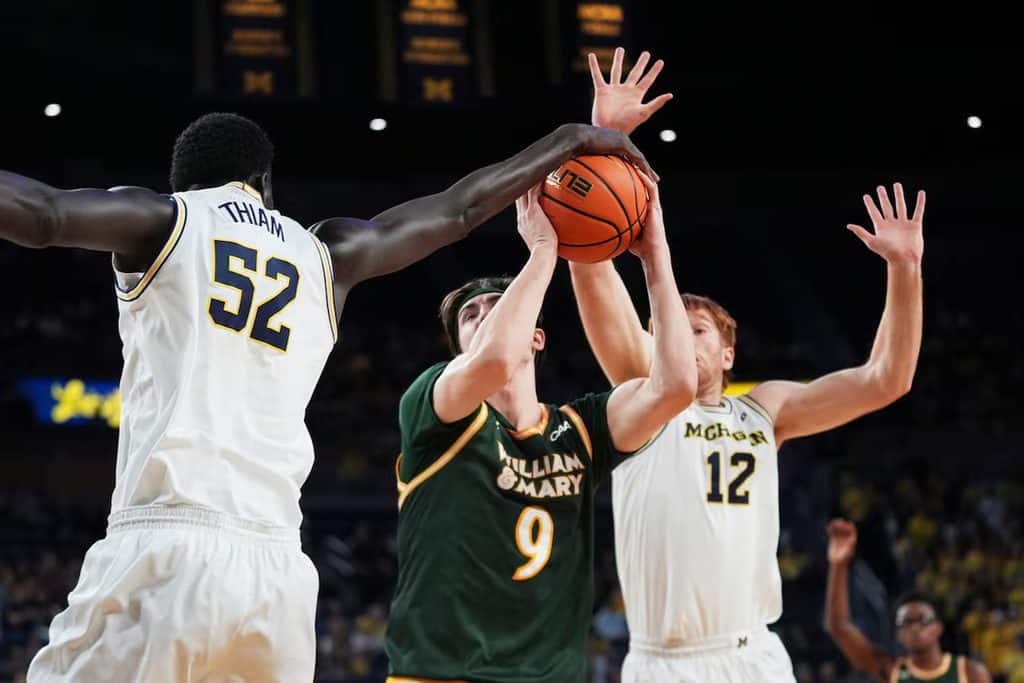
The Wolverines scored 123 points against William & Mary on November 15, winning 123-79. That followed an 84-70 victory over Marquette and an 85-77 loss to UConn earlier in the month.
Through four games, Michigan is averaging 92 points, although the William & Mary result accounts for a substantial share of that production.
The more interesting number involves ball movement.
According to Michigan’s official game notes, the Wolverines recorded 82 assists on 132 baskets entering Saturday. That means assists accompanied approximately 62% of their made field goals.
Elliot Cadeau has been central to that distribution, producing consecutive points-and-assists double-doubles against Marquette and William & Mary.
Against Villanova, that passing could become especially important.
Michigan has several offensive options capable of making defenses uncomfortable. Trey McKenney provides perimeter scoring, J.P. Estrella offers efficient production closer to the basket, and Moustapha Thiam adds size and a defensive presence around the rim.
That combination gives the Wolverines different ways to attack.
Villanova cannot simply pressure Michigan’s guards without accounting for interior scoring opportunities. But collapsing too aggressively toward the basket can leave the Wolverines with open perimeter looks.
There is a caution in the numbers.
Michigan’s season scoring average benefits significantly from a 44-point victory over William & Mary. The more relevant comparison may be its games against UConn and Marquette, when opposing defenses provided substantially greater resistance.
For totals bettors, 92 points per game is a starting point, not a reliable prediction of Saturday’s offensive output.
Villanova’s Pittsburgh Loss Revealed a Second-Half Problem
Villanova’s most recent game offered a revealing example of how quickly defensive control can disappear.
The Wildcats lost 81-61 at Pittsburgh on November 17, but the final score does not tell the entire story.
Villanova actually held a 51-50 lead midway through the second half before Pittsburgh took control.
According to Villanova’s official Michigan preview, Pittsburgh shot 16-for-26 from the field in the second half, including seven successful three-pointers on 11 attempts.
That second-half defensive collapse highlights the challenge awaiting Villanova against a Michigan team that consistently moves the ball.
The Wildcats need more reliable defensive possessions late in games, especially when opponents begin creating advantages through screening actions and passing.
Tyler Perkins was one of Villanova’s bright spots against Pittsburgh, scoring 19 points and collecting seven rebounds.
Devin Royal, meanwhile, entered the Michigan matchup averaging 14.8 points and 7.4 rebounds.
Royal’s familiarity with Michigan is particularly relevant. Before joining Villanova, he played at Ohio State and experienced the physical demands of Big Ten competition.
The Wildcats also have the size to challenge Michigan inside, but their effectiveness will depend on whether they can defend without losing rebounding position.
For Villanova, the objective is not simply to slow Michigan’s leading scorer. It is to prevent the Wolverines from repeatedly creating high-quality opportunities through second passes and offensive rebounds.
Injuries and Frontcourt Matchups Could Influence the Total
Both teams have personnel situations worth monitoring before tipoff.
Villanova guard Darryl Simmons II missed the Pittsburgh game because of a right ankle sprain. His availability for Michigan had not been confirmed in the official preview reviewed for this article.
Freshman center Luigi Suigo returned against Pittsburgh after missing the Rider game because of knee soreness. He played approximately 22 minutes, finishing with six points and five rebounds.
His return gives Villanova additional size against Michigan’s frontcourt.
Michigan also has injuries involving younger players.
Freshman guard Joseph Hartman has been recovering from a shoulder problem, while Lincoln Cosby continues rehabilitating from an ACL injury. Boynton indicated on November 19 that Hartman had a chance to return, but his availability remained subject to further evaluation.
Those uncertainties make confirmed rotation availability important before evaluating the spread or total.
The total of 159.5 points implies a reasonably productive offensive game.
However, Michigan’s ability to create second-chance points could influence that figure as much as its perimeter shooting.
Through four games, Michigan has averaged approximately 42.8 rebounds and 15.8 offensive rebounds per contest. Villanova has averaged around 41.2 total rebounds and 12.2 offensive rebounds through five.
These early-season averages suggest both teams can generate additional opportunities, but they do not establish which will control the glass Saturday.
Villanova needs its interior players to compete physically without committing excessive fouls. Michigan, meanwhile, must avoid turning offensive aggression into rushed possessions.
Rebounding and foul trouble can change the pace and scoring distribution more dramatically than a team’s season scoring average suggests.
Three Factors That Could Determine Whether the Spread Holds
The first factor is possession quality.
Michigan has demonstrated that its offense can generate opportunities for multiple players, but Villanova will try to prevent those possessions from developing comfortably. If the Wolverines consistently produce assisted baskets and secure offensive rebounds, the Wildcats could find it difficult to control the game.
The second is Villanova’s defensive response.
The Pittsburgh loss exposed problems when an opponent increased its offensive efficiency after halftime. Michigan offers a demanding test of whether the Wildcats have corrected those issues or whether another extended scoring run is possible.
The third is the relationship between the final margin and the available market.
A four-point spread and a five-point spread can require different judgments, even when the underlying analysis is identical.
Bettors also need to distinguish winning probability from betting value. Michigan can have a stronger chance of winning outright while its spread or moneyline still offers an unattractive price.
That distinction becomes increasingly important when the market moves in response to injury reports, public interest or changes in team availability.
What Saturday’s Game Means Beyond the Betting Market
Michigan and Villanova have considerable history, including their meeting in the 2018 national championship game.
The Wolverines won their most recent matchup 89-61 in December 2025, but this season features different personnel and new circumstances.
Michigan is defending a national championship while adjusting under Boynton. Villanova is attempting to establish itself as a serious Big East contender under Willard.
For the Wolverines, Saturday offers another opportunity to show that their offense can perform away from Ann Arbor against a recognizable opponent.
For Villanova, the game provides an immediate test of defensive discipline after the Pittsburgh defeat.
The most useful takeaway before tipoff is not that one team deserves automatic backing.
It is that a relatively narrow matchup spread, uncertain player availability and contrasting offensive profiles create several important variables. Understanding those variables matters, but securing a favorable number matters just as much.
Michigan may be the market favorite. Whether it represents value depends on the price available when the decision is made.