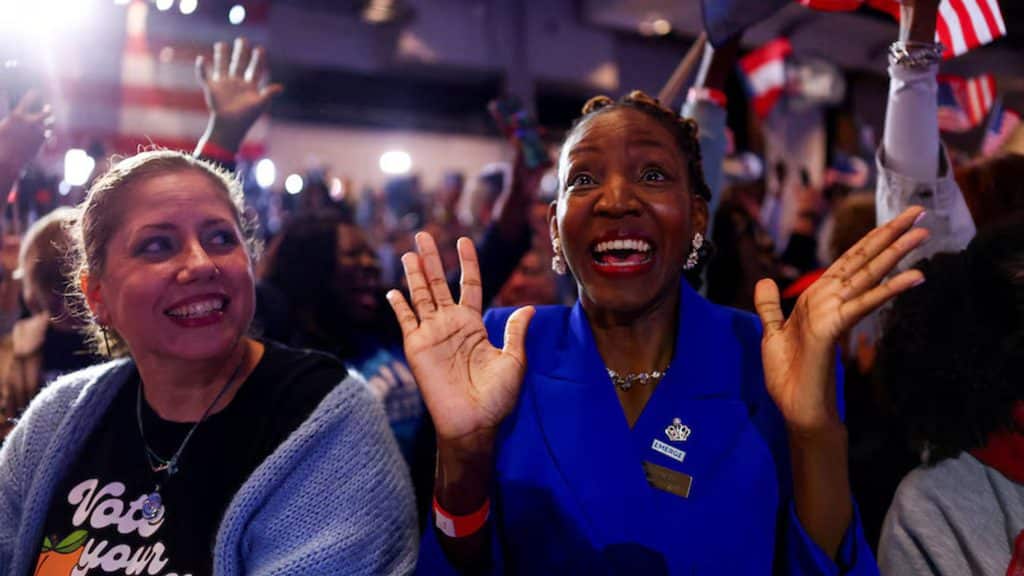
Democrats have won control of both chambers of Congress in the November 3, 2026, midterm elections, flipping at least seven Republican-held Senate seats and more than two dozen House districts. The results mark a significant change in Washington, giving Democrats legislative majorities for the final two years of President Donald Trump’s second term while several individual races remain unresolved.
The outcome also delivers the first major verdict on the Election Day prediction-market test that attracted more than $1.48 billion in reported trading activity. Markets eventually priced a Democratic congressional sweep as overwhelmingly likely, but the speed and timing of those moves matter when assessing how much useful information political contracts provided before voters’ choices became clear.
2026 Midterm Election Results Confirm a Democratic Congress
The Associated Press projected Democratic victories in both the House of Representatives and Senate after a series of Republican losses across traditionally competitive and reliably conservative states.
The results extended well beyond the handful of districts and statewide contests initially expected to determine control.
In the House, Democrats reached the 218-seat threshold required for a majority and gained more than 25 Republican-held districts.
The Senate delivered an even more consequential change.
Democrats captured Republican-held seats in Texas, Maine, Ohio, North Carolina, Iowa, Kansas and South Carolina, producing seven gains without losing control of their own major competitive seats.
The Associated Press election results also confirmed Democratic victories in Georgia and Michigan, where Republicans had invested heavily in competitive Senate races.
Congressional control has been projected, but the complete results are not yet certified.
Election authorities must finish counting eligible ballots and complete their legally required canvassing and certification processes. Individual races can remain unresolved even after the majority party in each chamber is known.
Seven Senate Victories That Changed the Political Map
The Senate results were especially notable because several Democratic victories occurred in states that had not elected a Democrat to the chamber for decades.
| State | Democratic Winner | Republican Opponent | Result |
|---|---|---|---|
| Texas | James Talarico | Ken Paxton | Democratic flip |
| Maine | Troy Jackson | Susan Collins | Democratic flip |
| Ohio | Sherrod Brown | Jon Husted | Democratic flip |
| North Carolina | Roy Cooper | Michael Whatley | Democratic flip |
| Iowa | Josh Turek | Ashley Hinson | Democratic flip |
| Kansas | Adam Hamilton | Roger Marshall | Democratic flip |
| South Carolina | Annie Andrews | Darline Graham | Democratic flip |
Texas delivered one of the election’s most significant changes.
State Representative James Talarico defeated Republican Attorney General Ken Paxton, ending a decades-long period without a Democratic victory in a statewide Texas election.
Kansas produced another historic result.
Adam Hamilton defeated incumbent Senator Roger Marshall, becoming the first Democrat elected to the U.S. Senate from Kansas since 1932.
In South Carolina, Annie Andrews defeated Republican Senator Darline Graham, breaking another longstanding pattern of Republican Senate victories.
Maine’s race ended Susan Collins’ nearly three-decade Senate career. Troy Jackson secured the seat for Democrats despite Collins’ reputation for occasionally breaking with Republican leadership.
North Carolina also changed hands, with former Governor Roy Cooper defeating Republican Michael Whatley for the seat being vacated by Republican Senator Thom Tillis.
Ohio and Iowa completed the seven-seat shift, with Sherrod Brown defeating Jon Husted and Josh Turek defeating Ashley Hinson.
These victories show why the Senate outcome cannot be explained entirely through a small number of traditional battleground states.
Democrats made gains across regions with different political histories, creating a broader geographic shift than the party needed merely to secure a majority.
House Results Reinforce the Nationwide Shift
The Democratic advance in the House reflected a similarly widespread change in electoral support.
Republicans lost more than two dozen districts, including seats in states where their candidates had benefited from strong presidential-election performances in 2024.
Democrats made gains in Iowa, Texas, Florida, Pennsylvania and several other states.
In Wisconsin’s 3rd Congressional District, Democrat Rebecca Cooke defeated Republican incumbent Derrick Van Orden, reversing the result of their previous general-election contest.
Sarah Trone Garriott also won Iowa’s 3rd Congressional District, adding to Democratic gains in a state where Republicans had controlled the entire congressional delegation heading into the election.
These results matter because House control depends on hundreds of district-level elections rather than a national popular vote.
A party can improve its national vote share without gaining enough strategically located seats to secure a majority.
In 2026, however, Democratic gains reached districts that had previously appeared relatively secure for Republicans.
That is what transformed a collection of local elections into a change in congressional control.
Democrats Also Capture Major Governorships
The congressional results were accompanied by Democratic victories in several major gubernatorial contests.
In Texas, Gina Hinojosa defeated Republican Governor Greg Abbott, who had been seeking a fourth term.
Georgia elected Democrat Keisha Lance Bottoms, the former Atlanta mayor, making her the first Black woman elected governor of a U.S. state.
Ohio elected Democrat Amy Acton over Republican Vivek Ramaswamy, while Iowa voters chose Democrat Rob Sand.
Wisconsin elected Democrat David Crowley, who will become the state’s first Black governor.
Republicans retained important positions as well.
In Florida, Byron Donalds won the governor’s race, becoming the first Black Republican elected governor in U.S. history.
These state-level results expand the political consequences beyond Congress.
Governors influence state budgets, education, transportation, emergency management and numerous regulatory decisions. Changes in state leadership therefore affect policy areas that Congress does not control directly.
What the Democratic Sweep Means for Prediction Markets
Political prediction markets entered Election Day facing questions about their credibility, liquidity and ability to interpret uncertain information.
Their largest platforms had already recorded substantial trading activity.
Reuters reported that Kalshi registered approximately $1.33 billion in midterm-related trading volume by November 2. Polymarket congressional contracts accounted for roughly $145 million based on figures compiled by the Anti-Corruption Data Collective.
Those amounts reflect different categories of trading activity and should not be interpreted as equivalent measures of money lost or individual wagers placed.
The more revealing development came as votes were counted.
In its Election Day prediction-market reporting, Reuters described prices moving rapidly toward a Democratic sweep after voting ended in the earliest states.
Analytics firm BETINT reported that prices aggregated across political markets were implying an almost certain Democratic takeover of both chambers by approximately 9 p.m. Eastern Time on November 3.
That eventual direction aligned with the projected results.
But correctly reflecting a developing election result is not the same as accurately forecasting it days or weeks in advance.
Market prices respond to new information, including vote counts, reporting from competitive districts and network projections.
Once those developments become public, the uncertainty surrounding many contracts can decline rapidly.
A fair assessment of prediction-market performance must therefore examine the prices available before meaningful election results emerged, not merely the prices reached after substantial votes had been reported.
The distinction is important for anyone using political contracts to evaluate risk rather than simply track election-night developments.
Why Uncalled Races Still Matter
By Wednesday morning, November 4, important Senate races in Alaska and Mississippi remained unresolved.
Those contests no longer determined which party would control the Senate, but their outcomes remained relevant to the final size of the Democratic majority.
House races still undergoing counting could also change the final balance between the parties.
Election-night calls are not identical to official certification.
A news organization may project a winner when its election analysts determine that the trailing candidate no longer has a realistic path to victory.
States nevertheless continue processing eligible ballots, conducting canvasses and completing certification procedures according to their own laws.
For election-contract holders, those distinctions can influence when a position becomes eligible for settlement.
Some contracts use an established consensus of election projections. Others rely on specific official decisions or later verification dates.
A broad congressional-control contract may therefore become effectively decided before every individual race has been certified.
That does not mean all contracts referencing the same election must resolve at the same time.
What Changes in Washington After the Midterms?
The Democratic congressional majorities are scheduled to take office in January 2027.
Until then, Republicans retain control of the outgoing Congress.
Once the new lawmakers are seated, Democrats will gain greater influence over federal legislative priorities, committee investigations and government oversight.
The Senate majority will also have the ability to reject presidential nominees requiring confirmation.
House Democrats can initiate investigations, hold hearings and use committee powers to scrutinize the executive branch.
However, congressional control does not automatically give Democrats the ability to enact their entire policy agenda.
President Trump retains the power to veto legislation, and the Senate’s procedural rules can still constrain the passage of major bills.
Republicans will also retain important political influence through the presidency and the state offices they continue to hold.
The new balance of power therefore creates opportunities for negotiation as well as potential legislative deadlock.
Economic policy, government spending, trade measures and federal oversight are likely to become significant areas of disagreement.
Those consequences will develop after the new Congress takes office rather than immediately changing federal law on Election Day.
Election Results Settle the Majority Question, Not Every Political Uncertainty
The 2026 midterm election results have answered the central question that dominated the campaign: Democrats will control both the House and Senate.
Seven Republican-held Senate seats changed hands, Democrats gained more than two dozen House districts, and several important governorships also shifted parties.
The remaining vote counts will determine the precise size of those victories.
For political prediction markets, the results create an opportunity for a more rigorous assessment of performance across both competitive and noncompetitive contracts.
The industry can point to prices that eventually reflected a Democratic congressional sweep. Whether those prices consistently provided useful information before the outcome became apparent requires a separate examination.
For Washington, the implications are more immediate.
The United States is entering the final two years of the Trump administration with a Congress controlled by the opposing party.
That change will reshape federal oversight, negotiations and legislative priorities well beyond the conclusion of Election Day.