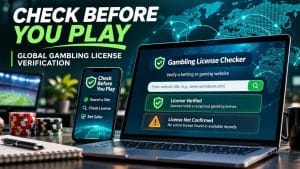
A new global gambling license checker is giving consumers another way to investigate online sportsbooks and casinos before depositing money. The tool, Check Before You Play, launched during the International Association of Gaming Regulators’ inaugural Illegal Gambling Awareness Week, November 9–13, 2026. Its arrival highlights a growing concern across the betting industry: professional websites, familiar brands and widespread advertising can make unlicensed gambling services appear more trustworthy than their regulatory status warrants.
The campaign comes as regulators in multiple countries strengthen consumer warnings and enforcement against unauthorized operators. Digital Wager Wire has previously examined regulatory concerns surrounding online sweepstakes operators, but this initiative introduces a broader consumer-focused approach. Instead of relying exclusively on enforcement after an operator enters a market, participating regulators want consumers to check authorization before creating accounts or sharing financial information.
Global Gambling License Checker Gives Consumers a New Verification Tool
The International Association of Gaming Regulators (IAGR) announced the initiative in October, outlining a coordinated campaign involving gambling authorities, consumer protection organizations and industry partners.
Its original campaign announcement described the first internationally coordinated awareness effort focused on identifying unlicensed online gambling services. The initiative also includes educational videos, social media materials and guidance that participating regulators can adapt to their jurisdictions.
At the center is Check Before You Play, a free licensing-information service contributed by Sharp Vision, a Paris-based regulatory technology company.
Consumers can access the online gambling license checker and select a country or available region before entering the website address of a sportsbook or casino they want to investigate. The service uses regulatory records and other verified public sources to return available licensing information.
For markets such as the United States, where online gambling authorization depends heavily on individual states, regional selection is particularly important.
However, the service has a significant limitation: its coverage depends on participating IAGR member jurisdictions and available data.
The checker is informational, not exhaustive. Its own guidance warns that records can be incomplete or may not reflect recent licensing changes. An absent result therefore should not automatically be treated as proof that an operator is illegal.
Customers should confirm the result through the relevant regulator’s official licensing register before depositing funds.
Michigan and Other Regulators Target Misleading Gambling Platforms
The campaign has attracted participation from regulators operating under different national and regional gambling frameworks.
On November 10, the Michigan Gaming Control Board reinforced its consumer protection campaign, urging residents to verify that online sportsbooks and casinos hold appropriate Michigan authorization.
In its official consumer warning, the regulator highlighted risks involving unauthorized betting websites and outlined protections required of locally licensed operators. These include age verification, player-fund protections, responsible gambling controls and regulatory complaint procedures.
Michigan has also pursued enforcement actions against businesses offering unlicensed wagering products, including sports-related prediction contracts.
The regulator confirmed that Polymarket US had agreed to stop offering new sports-event contracts to Michigan customers and close remaining open customer positions by November 25.
The distinction between licensing and product classification remains important. An operator may argue that certain contracts fall under federal financial regulation, while a state regulator may regard those same contracts as unauthorized sports wagering. These jurisdictional disputes are not automatically resolved by the new checker.
The central issue for consumers is whether the specific service they intend to use is legally authorized in their location.
Why Local Gambling Licenses Matter More Than International Recognition
Online gambling businesses can attract customers across borders without maintaining equivalent licenses everywhere they advertise.
A sportsbook might be authorized in one jurisdiction but lack permission to accept customers in another.
That distinction can become complicated when international sponsorships, social media marketing and affiliate promotions introduce betting brands to audiences outside their licensed markets.
British Columbia provides a clear example.
The province’s Independent Gambling Control Office explained in its November 9 public announcement that PlayNow.com, operated by the British Columbia Lottery Corporation, is the only legal and regulated online gambling platform permitted in the province. The authority warned that advertising exposure can create confusion about whether other gambling websites are authorized locally.
A license from another jurisdiction does not necessarily create permission to operate in British Columbia.
The same principle applies across many regulated markets: licensing must match the customer’s jurisdiction, not simply the operator’s country of incorporation or the location of an offshore registration.
For consumers, that can affect access to dispute resolution, complaint procedures, age-verification requirements and responsible gambling safeguards.
Licensed status does not guarantee that every customer will win, avoid fraud or receive a favorable outcome in a dispute. It does, however, establish a framework under which an authorized regulator can supervise the operator and enforce applicable rules.
How Consumers Can Identify Licensing Risks Before Depositing
The new verification service offers a useful starting point, but consumers should apply several checks rather than depend on a single website result.
| Verification step | What consumers should examine | Why it matters |
|---|---|---|
| Confirm local authorization | Operator name and license status in the relevant jurisdiction | Establishes whether the business is permitted to offer the service locally |
| Compare website information | Domain, company identity and license details against regulator records | Helps identify misleading claims or websites impersonating legitimate operators |
| Review consumer safeguards | Age verification, spending limits, self-exclusion and complaint procedures | Indicates which regulatory protections may apply |
| Examine withdrawal conditions | Payment methods, identification requirements and published withdrawal terms | Helps identify financial conditions before funds are deposited |
| Investigate unclear results | Contact the responsible regulator when records are missing or inconsistent | Avoids treating incomplete checker data as a definitive licensing decision |
These checks are especially relevant when a gambling platform promotes large bonuses, unusually generous offers or guaranteed outcomes.
Aggressive marketing alone does not establish illegal activity. However, promises of guaranteed winnings or an inability to identify the company behind a website should prompt additional investigation.
Consumers should also be cautious about sharing identity documents, payment information or cryptocurrency wallet credentials with an operator whose licensing status cannot be confirmed.
The practical objective is not to identify which operator offers the most attractive promotion. It is to establish whether meaningful consumer safeguards apply before financial exposure begins.

What the New Licensing Initiative Means for the Betting Industry
Illegal Gambling Awareness Week reflects a broader change in how regulators are approaching unauthorized online gambling.
Enforcement actions such as cease-and-desist orders, payment restrictions and website blocking remain important. Yet they can be difficult to coordinate when websites advertise internationally and operate across multiple jurisdictions.
Consumer education provides another approach.
By promoting a shared verification tool, regulators can encourage customers to investigate authorization independently rather than relying on an operator’s branding or marketing claims.
That could also affect competitive conditions in regulated betting markets.
Authorized operators incur costs associated with compliance systems, regulatory reporting, responsible gambling controls and customer protection.
Businesses operating without equivalent local obligations may face different operating expenses, potentially creating uneven competition.
A widely used licensing-information service could make those differences more visible to consumers. However, there is not yet sufficient evidence to conclude that the new initiative has reduced illegal gambling participation or redirected a measurable share of customers toward licensed platforms.
Those outcomes will require data about consumer awareness, actual use of the checker and subsequent changes in gambling behavior.
Another challenge is maintaining accurate information.
Gambling licenses can be issued, suspended, renewed or revoked. Regulatory frameworks can also change, meaning a website that appears authorized today may have a different status later.
A licensing check is a starting point, not a permanent guarantee of legal compliance.
The Real Test Begins After Awareness Week
The conclusion of Illegal Gambling Awareness Week on November 13 marks the end of the coordinated campaign, but not the underlying regulatory challenge.
Online gambling operates across national and regional boundaries, while licensing rules and enforcement powers remain jurisdiction-specific.
Check Before You Play introduces a practical resource intended to reduce confusion about that difference. Its value will depend on how effectively consumers use it, how broadly participating jurisdictions contribute information and how reliably the underlying records remain current.
For sportsbook and casino operators, the initiative reinforces the commercial importance of transparent licensing information and effective consumer protections.
For regulators, it creates an opportunity to evaluate whether public education can complement enforcement against unauthorized businesses.
And for anyone considering an online betting account, the immediate lesson is straightforward: a recognizable brand, prominent advertisement or professional website should never substitute for verifying whether the operator is authorized to provide the intended gambling service where the customer lives.