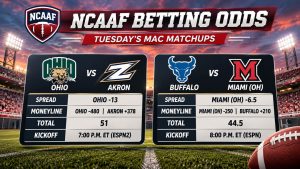
Ohio was initially the underdog against Miami (Ohio). By Monday, the Bobcats had become the favorite at several major sportsbooks. That reversal is the standout development ahead of Tuesday’s three-game Mid-American Conference football schedule.
The Week 11 MACtion odds now place Ohio approximately 1.5 points ahead of Miami, while Western Michigan is favored by roughly two touchdowns at Akron. Bowling Green, despite holding a worse overall record than Kent State, is favored by almost six points in the night’s other matchup.
Those numbers create three different betting questions. Ohio’s market is reconsidering the relative strength of two conference rivals. Western Michigan must justify a substantial road spread. Bowling Green is being favored on matchup characteristics that its overall record does not immediately reveal.
For bettors reviewing prices through Digital Wager Wire’s sportsbook comparison guide, the most useful information is not simply which team is favored. It is how recent performances, statistical mismatches and changing prices explain each number.
Week 11 MACtion Odds: Tuesday’s Three-Game Betting Board
All three games take place Tuesday, November 10, 2026. The following snapshot reflects FanDuel’s published November 9 prices.
| Matchup | Spread | Moneyline | Total | Kickoff (ET) |
|---|---|---|---|---|
| Kent State at Bowling Green | Bowling Green -5.5 | BG -205 / Kent +168 | 45.5 | 7:00 PM |
| Western Michigan at Akron | Western Michigan -14.5 | WMU -710 / Akron +520 | 47.5 | 7:00 PM |
| Ohio at Miami (OH) | Ohio -1.5 | Ohio -118 / Miami -102 | 48.5 | 8:00 PM |
Odds snapshot: November 9, 2026. Prices differ by sportsbook and may change before kickoff.
The range between the three spreads is substantial.
Ohio-Miami is essentially a pick’em, with a slight advantage given to the Bobcats. Bowling Green is favored by just under a touchdown, while Western Michigan must win by more than two touchdowns to cover its listed spread.
The moneylines tell a similar story.
Ohio’s -118 price indicates a comparatively even contest. Western Michigan’s -710 reflects the market’s much greater confidence in the Broncos winning outright.
Neither price establishes that a wager offers value. The important question is whether the underlying football matchup supports the cost of taking that position.
Ohio-Miami: Why the Betting Market Changed Favorites
The most meaningful line movement on Tuesday’s board involves Ohio and Miami.
Miami opened as approximately a 1.5-point home favorite. By November 9, several major sportsbooks had switched to Ohio -1.5.
That represents a three-point change in the quoted spread, including a reversal of the favored team.
Not every sportsbook has moved identically. Some still show different prices or a slight Miami advantage, making this a market where comparing the actual available number is particularly important.
Ohio enters at 7-2 overall and 5-0 in MAC play, riding a six-game winning streak.
Miami is 5-4 overall and 3-2 in conference games after losing 34-31 to Buffalo in overtime.
The recent results help explain why the market might be reassessing the matchup.
Ohio defeated Akron 28-20 on November 3, extending its unbeaten conference run. Quarterback Nick Poulos threw for 197 yards and a touchdown while adding 45 rushing yards and another score.
Running back Duncan Brune contributed 111 rushing yards and a touchdown.
Miami experienced a more frustrating result.
The RedHawks led Buffalo 31-16 late in the third quarter but surrendered the advantage before losing in overtime. Miami generated two interceptions and scored on a blocked punt, yet those opportunities were not enough to secure the victory.
The official Ohio rivalry preview also confirms that the Bobcats have won the last two meetings between the programs, including a 24-20 victory in 2025.
But recent results and rivalry history are only part of the explanation.
The most important matchup may be Ohio’s rushing offense against Miami’s defensive front.
Miami’s Run Defense Makes Ohio’s Favorite Status Less Straightforward
Ohio averages approximately 188.9 rushing yards per game, ranking among the nation’s top 35 rushing offenses.
Miami allows just 97.6 rushing yards per game, a top-15 defensive figure nationally.
That is a genuine strength-versus-strength matchup.
Ohio wants to control possession, create manageable third downs and avoid forcing Poulos into predictable passing situations.
Miami’s defensive front has demonstrated that it can limit rushing production, potentially requiring the Bobcats to find more of their offensive success through the air.
That introduces another important statistical contrast.
Miami allows approximately 279.7 passing yards per game, compared with Ohio’s 202.0.
Ohio also converts 47.7% of its third downs, while Miami’s defense allows opponents to convert 41.3%.
Those figures suggest the Bobcats may have opportunities to sustain possessions even if Miami makes rushing yards difficult to obtain.
For Miami, the challenge is generating enough offensive consistency to finish drives and prevent Ohio from dictating the pace.
Running back D’Shawntae Jones rushed for a career-high 112 yards against Buffalo, showing that the RedHawks have offensive options beyond quarterback Caleb Heavner.
The line movement is therefore understandable without treating it as a prediction.
Ohio has the stronger record, greater conference momentum and a favorable passing matchup. Miami has a strong run defense, home field and a history of competing effectively in important MAC games.
At Ohio -1.5, those differences produce a narrow market advantage rather than an expectation of a decisive Bobcats victory.
Western Michigan-Akron: Why Two Touchdowns Is a Demanding Number
Western Michigan enters Tuesday at 6-3 overall and 4-1 in conference play.
Akron is 1-8 and has lost its first five MAC games.
That difference makes Western Michigan’s position as the favorite unsurprising.
The more interesting issue is whether the Broncos can justify laying 14 to 14.5 points on the road.
Western Michigan secured bowl eligibility with a 23-10 victory over Bowling Green on October 31.
Running back Cole Cabana delivered a career-best performance, rushing for 110 yards and a touchdown on seven carries. Jalen Buckley added 77 rushing yards, while quarterback Broc Lowry threw for 146 yards and one touchdown.
The Broncos official Bowling Green game recap showed how effective their rushing attack can be without requiring an especially productive passing performance.
Western Michigan also defeated Kent State 38-7 earlier in October, demonstrating that it can produce comfortable victories against struggling conference opponents.
But Akron’s most recent result deserves attention.
The Zips lost 28-20 to Ohio on November 3, remaining within eight points of a team that is undefeated in MAC play.
Akron even held a second-half lead before Ohio pulled away.
That performance does not erase Akron’s substantial season-long weaknesses. It does illustrate why a large road spread requires more analysis than comparing win-loss records.
Western Michigan must establish offensive control early, avoid turnovers and prevent Akron from extending drives.
A 10-point Broncos victory would reinforce the difference in team quality while still failing to cover -14.5.
That is the distinction between expecting Western Michigan to win and establishing whether its spread is appropriately priced.
Kent State-Bowling Green: The Worse-Record Team Is Favored
Bowling Green is 2-7. Kent State is 3-6.
Yet the Falcons are favored by approximately 5.5 to six points at home.
The difference is more understandable when examining the teams’ offensive limitations.
Bowling Green averages 17.8 points per game. Kent State produces only 14.3.
Neither team has demonstrated consistent scoring ability.
However, Bowling Green has been considerably more effective against the pass, allowing approximately 168.8 passing yards per game.
Kent State, meanwhile, averages only 99.2 rushing yards per contest and 188.6 passing yards.
That creates a difficult offensive assignment for the Golden Flashes.
The Falcons’ rushing defense is less convincing, allowing approximately 212 yards per game. But Kent State has not demonstrated the consistent rushing production needed to exploit that weakness.
The teams are also tied at 2-3 in conference play despite their different overall records.
Bowling Green’s official Tuesday matchup notes confirm that Kent State won last season’s meeting 24-21, while the Falcons won the previous two matchups.
The betting market is therefore not simply ignoring the standings.
It is assigning value to Bowling Green’s home field and defensive characteristics while questioning Kent State’s ability to generate enough offense to win.
There is still a reason to approach the spread carefully.
Bowling Green has not been a productive offensive team itself. When the favorite averages fewer than 18 points per game, creating a comfortable margin can be difficult even against a vulnerable opponent.
A lower-scoring contest would make every turnover, special-teams mistake and red-zone opportunity more consequential.
What the Three Totals Suggest About Tuesday’s Games
The totals range from 45.5 points in Kent State-Bowling Green to 48.5 in Ohio-Miami.
Those expectations are relatively close despite the substantial differences between the spreads.
Combining each listed point spread with its total produces approximate market-implied scores:
| Matchup | Favorite’s Implied Points | Underdog’s Implied Points |
|---|---|---|
| Bowling Green-Kent State | 25.5 | 20.0 |
| Western Michigan-Akron | 31.0 | 16.5 |
| Ohio-Miami (OH) | 25.0 | 23.5 |
These are mathematical illustrations derived from the listed spreads and totals, not independent score predictions.
Western Michigan has the highest implied team total of the three favorites.
Ohio-Miami has the smallest expected scoring separation, consistent with the near-pick’em spread.
Bowling Green-Kent State presents a particularly interesting problem: the market is projecting substantially more combined scoring than the two offenses’ modest season averages would initially suggest.
That expectation may reflect the defensive weaknesses both teams have exhibited, but offensive inefficiency remains an important counterargument.
A total is not attractive simply because two defenses allow points. The offenses must also demonstrate that they can take advantage of those opportunities.
The Betting Outlook: Three Different Tests of Market Confidence
Tuesday’s MACtion schedule shows why point spreads need context.
Ohio has emerged as the favorite against Miami, but the difference remains narrow because the RedHawks possess a strong rushing defense and home-field advantage.
Western Michigan has earned its status as a substantial favorite over Akron, although covering more than two touchdowns requires a level of separation that Ohio did not achieve against the Zips last week.
Bowling Green is favored despite having fewer wins than Kent State, largely because the Golden Flashes have struggled to generate offense against defenses capable of limiting the passing game.
These are three distinct situations.
Ohio-Miami is about market movement and conflicting matchup strengths.
Western Michigan-Akron is about the difference between winning comfortably and covering a large road spread.
Kent State-Bowling Green is about why defensive matchups can outweigh an overall-record comparison.
The biggest development in the Week 11 MACtion odds remains Ohio’s shift from underdog to favorite.
But that movement alone does not prove which team offers value.
The most useful approach is to evaluate the football matchup first, then determine whether the available spread and price accurately reflect those advantages.
With conference positioning becoming increasingly important in November, Tuesday’s results will offer another test of how well the betting market is measuring the MAC’s leading teams and struggling programs.