The CAMELS bank rating overhaul matters because it targets one of the quietest but most powerful tools in U.S. banking supervision. If regulators change how banks are graded, the impact could reach far beyond examiner meetings, shaping lending decisions, business expansion, regulatory pressure, and how much room banks have to operate.
For most consumers, CAMELS is invisible. For banks, it can decide whether an institution is treated as healthy, constrained, or in need of closer oversight.
CAMELS Bank Rating Overhaul Puts Supervision Under Pressure
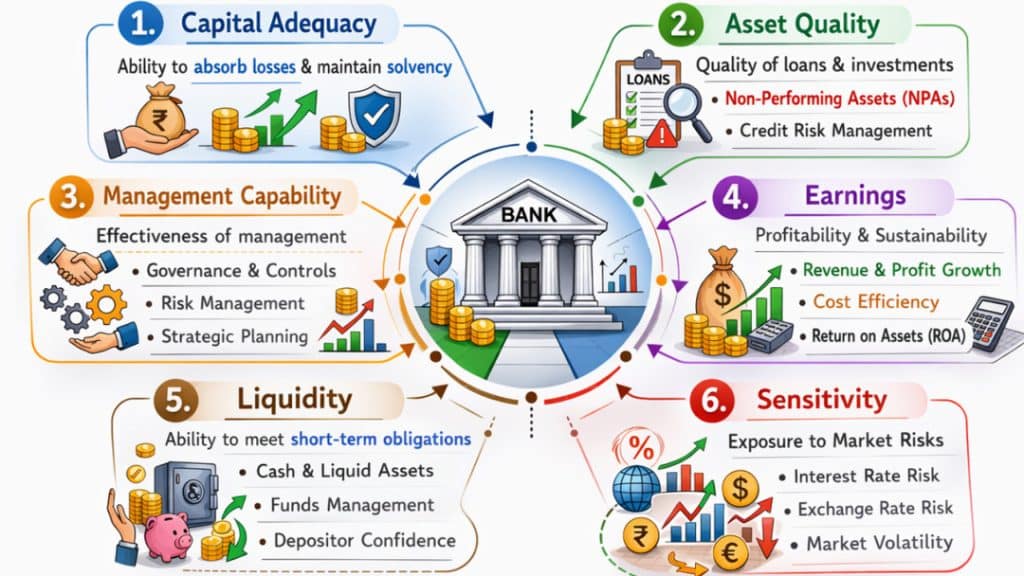
The latest CAMELS bank rating overhaul proposal focuses on the confidential rating system examiners use to judge a bank’s condition. CAMELS stands for capital adequacy, asset quality, management, earnings, liquidity, and sensitivity to market risk. Those categories may sound technical, but they influence how much supervisory pressure a bank faces.
The proposal is significant because it aims to make the system more focused on core financial risks, more transparent, and less dependent on subjective examiner judgment. That does not mean regulators are stepping away from oversight. It means they are trying to make the process more tied to material financial risks rather than weaker documentation, internal process gaps, or judgment calls that may not directly threaten safety and soundness.
That distinction matters. A bank with strong capital, solid liquidity, and manageable loan risk may argue that it should not be treated like a troubled institution because of supervisory concerns that are less connected to financial condition. Regulators, meanwhile, still need enough discretion to catch weak management before problems become obvious in the numbers.
Why A Confidential Rating Can Carry Public Consequences
CAMELS ratings are not consumer-facing scores. Customers do not usually see them, and banks do not market them. Yet the consequences can be very real. A weaker rating can invite closer scrutiny, restrict growth plans, complicate acquisitions, or force management to spend more time answering exam concerns.
That is why banks care so much about the definitions behind the ratings. If the system is too vague, institutions may feel they are being judged by shifting expectations. If the system is too rigid, regulators may lose the ability to respond to early warning signs. The challenge is finding a middle path that supports fair supervision without weakening the safety net.
The Federal Financial Institutions Examination Council’s proposed rating-system revisions show that regulators are trying to retain the basic CAMELS structure while changing how ratings are defined and applied. That signals a reform effort, not a full replacement.
The best way to understand the debate is to compare what the current system emphasizes with what the proposed direction appears designed to strengthen.
| Area | Current Concern | Proposed Direction |
|---|---|---|
| Rating judgment | Can feel subjective to banks | More transparent evaluation factors |
| Supervisory focus | May include process-heavy criticism | Greater focus on financial risk |
| Bank impact | Ratings can restrict activity | Ratings tied more closely to condition |
| Examiner discretion | Broad room for judgment | More predictable standards |
| Safety and soundness | Central purpose of the system | Still the core objective |
The table shows why this is not a simple deregulation story. The issue is whether supervision should punish weaknesses that look procedural, or reserve the heaviest consequences for risks that clearly affect a bank’s financial health.
The Lending Angle Is Easy To Miss
The banking industry will naturally frame this proposal around fairness and predictability. That argument has force. But the broader economic angle is lending. When banks feel boxed in by supervisory ratings, they may become more cautious about growth, acquisitions, credit expansion, or new products.
That caution is not always bad. Bank regulation exists because excessive confidence can damage depositors, borrowers, and the wider financial system. Still, if supervision becomes too blunt, it can discourage useful lending even at institutions that are financially sound.
This is where the CAMELS debate connects to the broader movement of money through the banking system. Deposits, credit demand, private lending competition, and customer behavior all shape how banks make decisions. The same pressure can be seen in the movement of bank deposits as savers compare rates and banks work harder to hold funding.
A more predictable rating framework could give well-run banks more confidence to lend. But that benefit only holds if the new system still catches genuine weakness early. The point is not to make supervision easier for its own sake. The point is to make it sharper.
The Risk Is Making The System Too Mechanical
There is a clear upside to less subjective supervision. Banks should know what they are being judged on. Regulators should be able to explain why a rating changed. A process that feels arbitrary can erode trust and make compliance more expensive than necessary.
The risk is that regulators could overcorrect. Banking problems do not always announce themselves neatly through capital ratios or liquidity metrics. Management quality, internal controls, risk culture, and governance can matter before the balance sheet shows visible stress. A bank can look fine on paper while developing weaknesses that become costly later.
That is why management remains the hardest CAMELS category to reform. It is also the category most likely to trigger disagreement. Banks often want more measurable standards. Examiners often want room to judge leadership quality, risk controls, and responsiveness. Both sides have a point.
The danger is treating every subjective judgment as unfair. Some judgment is necessary in bank supervision. The better question is whether that judgment is clearly connected to safety and soundness, communicated consistently, and supported by evidence.
Why This Could Become A Bigger Regulatory Fight
The CAMELS proposal arrives at a moment when U.S. bank regulation is already under review. Capital rules, stress testing, liquidity expectations, merger approvals, and supervisory findings have all been part of the broader policy debate. A rating-system change would fit that larger pattern.
Banks may see the proposal as a chance to reduce a quieter compliance burden. Consumer advocates and stricter-regulation voices may worry that softening ratings could make it easier for weak institutions to expand. Regulators will likely present the shift as modernization rather than relaxation.
The language matters. If the final framework emphasizes “material financial risks,” banks will read that as a sign that procedural shortcomings may carry less weight unless they connect to real financial danger. If the framework preserves broad management discretion, examiners will still have significant authority to act when they see poor governance or risk controls.
That is why the final definitions will matter more than the headline. A small wording change in how management, liquidity, or composite ratings are defined could change how exam teams behave across the system.
The Details That Will Reveal The Real Direction
The next signal will be how regulators handle comments from banks, trade groups, consumer advocates, and policy critics. If the final version keeps the reform narrow, the system may become clearer without changing much in practice. If the changes are more aggressive, banks may gain greater operating flexibility.
The most important details will be how examiners weigh management weaknesses, how ratings connect to enforcement actions, and whether the new language truly limits subjective downgrades. Readers should also watch whether community banks and large banks experience the changes differently. A rule can look uniform on paper but feel very different depending on size, complexity, and examiner expectations.
The strongest version of reform would improve transparency while preserving early-warning power. The weakest version would either leave banks confused or make regulators slower to act. That is the real test of the proposal.
The CAMELS bank rating overhaul deserves attention because it could quietly reset the relationship between banks and supervisors. If done well, it may make oversight more predictable, risk-focused, and credible. If done poorly, it could either weaken guardrails or leave the old frustrations untouched. The fight is not just about how banks are graded; it is about how much trust the financial system places in judgment, numbers, and the space between them.