Digital Wager Wire highlights the most significant events affecting the domestic and international sports betting and gaming industries each week throughout the year.
Online betting apps are no longer moving through the U.S. gambling market with the same easy expansion story that defined the early post-PASPA years. This week’s industry news shows a sharper split: mobile betting is facing political pushback, prediction markets are testing state control, and land-based casinos are still looking for new growth.
That tension matters for anyone following operators, bettors and market access across the best U.S. betting sites. The next phase of gambling growth may not be decided only by who has the best app or biggest promo budget. It may be decided by which products regulators still trust.
Online Betting Apps Face A Rollback Test In Ohio
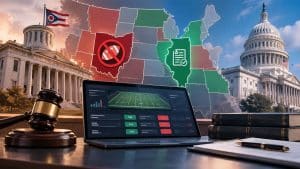
Ohio is the clearest warning sign for the online betting industry. Lawmakers introduced a proposal that would repeal the state’s online sports betting market, a move that would represent a major reversal in one of the country’s more visible regulated wagering states.
Use up and down arrow keys to resize the meta box pane.
The proposal does more than target mobile betting access. It would also restrict several betting formats that have become central to modern sportsbook apps, including prop bets, live betting, parlays and college markets. The plan includes limits on wager size and daily betting volume, turning the debate from simple legalization into a much broader question about product design.
That is the key shift. The political concern is not only whether sports betting should exist. It is whether mobile betting has become too fast, too flexible and too easy to access.
The online betting repeal proposal is unlikely to be the final word on Ohio’s market, but it gives other states a template. Even if repeal fails, limits on props, live betting, deposit methods or advertising could become the more realistic regulatory fight.
For operators, that creates a new policy risk. A state can legalize online sports betting, build tax revenue around it, and still return later with pressure to narrow the product.
Nebraska Shows Expansion Is Not Finished
Ohio is not the whole story. Nebraska is moving in the opposite direction, with online sports betting advocates pushing the issue closer to a possible ballot decision. That matters because the U.S. market is still uneven. Some states are trying to expand mobile wagering access while others are questioning whether the product has gone too far.
That split is what makes this moment important. The U.S. betting map is not simply maturing into one standard model. It is becoming more fragmented, with different states making different judgments about risk, tax revenue, consumer behavior and political backlash.
For online betting apps, that means growth may be slower and more state-specific. Operators can no longer assume that legalization momentum will move in one direction. They may win access in one state while defending existing access in another.
Nebraska also shows why online wagering remains attractive to lawmakers and campaign groups. Mobile betting can create tax revenue, consumer convenience and a modern alternative to retail-only markets. But the Ohio debate proves that expansion now comes with a heavier burden: operators must show they can grow without creating a political reaction.
Prediction Markets Are Becoming The Middle Fight
Prediction markets sit between finance, gambling and technology, which is exactly why states are paying attention. Platforms such as Kalshi and Polymarket argue that event contracts belong under federal commodities oversight, while state gaming regulators worry that sports and political event markets can look too much like betting products.
New Jersey has moved toward a tax approach, advancing a scaled-back proposal aimed at prediction-market income. That is different from an outright ban, but the message is similar: states do not want fast-growing event markets operating entirely outside their revenue and consumer-protection systems.
The broader picture is even bigger. Lawmakers in at least 16 states introduced legislation this year to regulate prediction markets in some form, with some measures aimed at restricting who can use them and what types of events can be traded.
That makes prediction markets the regulatory gray zone of the gambling industry. They are not traditional sportsbooks. They are not classic casino products. Yet they compete for attention, deposits and event-driven speculation in ways that overlap with both.
If states cannot stop them outright, taxes and product-specific rules may become the next battleground.
Casinos Keep Expanding While Apps Face Pressure
The land-based casino story looks different. North Carolina is showing that physical casino expansion still has momentum, with the Catawba Nation planning additional casino projects while continuing to build around Catawba Two Kings Casino Resort in Kings Mountain.
That is an important contrast. Online betting apps are facing questions about speed, accessibility and product limits. Casinos, by comparison, can still frame expansion around jobs, tourism, tribal economic development and destination entertainment.
Those are easier political arguments in some markets. A casino project is visible. It can be tied to construction, employment and regional development. A sportsbook app is less tangible, even if it generates tax revenue.
This does not mean casinos face no resistance. Local opposition, licensing fights, tribal-state negotiations and market saturation still matter. But the current news cycle shows that land-based gambling can still grow while mobile betting faces a more skeptical political climate.
That split gives the industry two different growth stories at once: physical casinos expanding through place-based investment, and mobile operators defending the scale and structure of app-based betting.
Macau Shows Sports Can Move Casino Spending
Macau adds the global signal. June gross gaming revenue fell 12.1% year over year to MOP18.52 billion, or about $2.29 billion, with the football World Cup cited as one factor pulling attention and spending away from casino floors.
That is not just a Macau story. It shows how major sports events can shift gambling behavior across verticals. When the World Cup is on, some customers may move attention from tables and slots toward sports, betting markets, bars, screens and event-driven entertainment.
The Macau revenue decline also matters because it challenges the old idea that casino demand sits apart from sports demand. In a more connected gambling economy, customer attention moves quickly.
That puts pressure on operators to think across products. Casinos, sportsbooks, online betting apps and event markets are not separate worlds anymore. They are competing for the same time, wallet share and emotional moments.
The Industry Signal Is Fragmentation
The cleanest way to read this week’s news is not “online is winning” or “casinos are back.” The better read is fragmentation.
| Industry Signal | What Happened | Why It Matters |
|---|---|---|
| Ohio sports betting | Lawmakers introduced a repeal bill | Mobile betting can still face rollback pressure |
| Nebraska expansion | Online betting petitions moved closer to ballot consideration | Legalization momentum remains active in some states |
| New Jersey prediction markets | Lawmakers advanced a tax-focused approach | States may seek revenue even if bans are harder |
| State regulation | Multiple states are targeting prediction markets | Federal and state oversight remain unresolved |
| North Carolina casinos | Catawba expansion plans keep moving | Land-based casino growth still has political room |
| Macau revenue | June GGR dropped during World Cup activity | Sports events can shift casino spending patterns |
The table shows an industry being pulled in different directions. Online betting apps are convenient but politically exposed. Prediction markets are innovative but legally unsettled. Casinos are capital-heavy but still useful to governments and tribes seeking local economic impact.
Online betting apps remain central to the modern gambling business, but they are entering a more complicated stage. The next major industry winners may not be the operators that expand fastest. They may be the ones that can survive tighter rules, defend consumer trust, adapt to state-by-state pressure and still compete when casinos, sportsbooks and prediction markets are all fighting for the same gambling dollar.