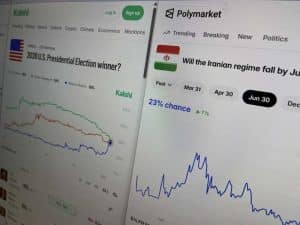
Election prediction markets have spent 2026 becoming more visible, more heavily marketed and more deeply embedded in political coverage. Yet a new national poll suggests the industry’s regulatory progress is moving faster than its public acceptance.
That gap matters because the debate is no longer simply about whether Americans understand how prediction markets work. The harder question is whether people view contracts on elections, military action and government decisions as useful financial instruments or simply another form of gambling attached to events they do not believe should be wagered on.
Election Prediction Markets Face Bipartisan Skepticism
A Reuters/Ipsos poll conducted from September 30 through October 5 found substantial opposition to election wagering across party lines. Among respondents identifying as Democrats, 69% opposed using prediction markets to bet on election results, compared with 61% of Republicans. The nationwide online survey included 4,506 U.S. adults and carried a margin of error of about two percentage points.
The resistance extended beyond elections. Sixty-five percent opposed prediction-market wagering on U.S. military actions, while 63% opposed contracts tied to government policy announcements or decisions. Only 8% and 9%, respectively, supported those two categories. The new public-opinion findings make the industry’s challenge unusually clear.
This is not a conventional red-versus-blue divide.
It is a broader disagreement over what types of uncertainty should become tradable.
That distinction matters.
An election contract may look technically similar to a contract on inflation or weather, but the public can attach very different ethical weight to the underlying event.
Federal Recognition Does Not Equal Public Acceptance
The timing of the poll is especially interesting because federal regulators are moving in the opposite direction on a separate question: how event contracts should be classified.
On October 9, the Commodity Futures Trading Commission proposed explicitly including event contracts based on sports, politics, culture and weather within the definition of a swap. CFTC Chairman Michael S. Selig said the agency views those products as commodity derivatives falling within its federal regulatory authority. The proposal remains subject to public comment and is not yet a final rule.
The CFTC event-contract proposal therefore creates an important contrast. Federal recognition as a derivatives product does not automatically settle whether the public thinks the activity resembles investing, hedging or gambling.
That gap is becoming central to the industry.
Three-quarters of respondents in the Reuters/Ipsos poll said using prediction markets to wager on real-world outcomes amounted to gambling. Only 8% said it did not.
Legal classification and perception are different questions.
A regulator can classify a product under federal commodities law while consumers still experience it as a wager.
Government Events Create a Harder Insider-Information Problem
The most difficult prediction-market products may not be elections themselves.
Contracts tied to military operations or government policy decisions introduce an information problem that sports markets rarely encounter at the same level.
Government officials, political staff, military personnel and contractors can potentially possess material information unavailable to ordinary traders. That does not mean every market is compromised, but it makes access to nonpublic information a central design and enforcement issue.
The poll reflected that concern strongly. Among Democrats, 93% said it was inappropriate for members of Congress or their staff to bet on political events. Among Republicans, 89% said the same.
Both Kalshi and Polymarket say they maintain controls intended to detect misconduct and cooperate with authorities when suspicious activity appears. Kalshi also says it bars political candidates from trading on their own races and does not offer markets on military operations.
Those safeguards address part of the problem.
They do not eliminate the broader question of whether some events should be tradable at all.
Access to information matters more when the event itself is being shaped by people who may also know its likely outcome before the public does.
Prediction Markets Now Have Two Legitimacy Battles
For much of the industry’s recent growth, the main legal fight has centered on jurisdiction.
Prediction-market companies have argued that their federally regulated event contracts belong under commodities law. State regulators have countered that at least some sports-event contracts function like gambling products and should therefore be subject to state wagering rules.
Public opinion creates a second front.
Even if the industry succeeds in establishing broad federal jurisdiction, it still has to persuade customers, lawmakers and institutions that trading on elections or government decisions provides enough informational or hedging value to justify the ethical concerns.
That is not the same problem as winning a court case.
A platform can be legal while unpopular. A federally supervised product can still face political pressure. And a rapidly growing market can attract substantial trading activity without demonstrating broad social approval.
This is where the public-opinion data adds something that trading volume cannot.
Volume tells us people are participating.
Polling tells us what the larger public thinks about the activity.
Those signals can point in different directions at the same time.
The Industry’s Next Test Is Product Boundaries
The most consequential question for election prediction markets may therefore be less about whether the category survives and more about where regulators and platforms draw boundaries.
Contracts on an election winner are one thing. Markets involving legislation, military action or government officials’ decisions create different concerns about influence, confidential information and public trust.
The CFTC is moving toward a framework that treats event contracts as part of federal derivatives regulation, while its broader 2026 rulemaking has also examined whether particular categories — including gaming, war and other statutorily listed activities — require additional scrutiny.
That distinction could become more important than the industry’s familiar argument over whether prediction markets are simply gambling by another name.
The real issue is boundaries.
The Reuters/Ipsos findings do not decide what products regulators should permit, and polling does not determine the legal meaning of an event contract. But the survey does establish a useful warning for the industry: regulatory recognition and public legitimacy are not progressing at the same speed.
Election prediction markets may continue gaining users, capital and federal regulatory structure. Their next challenge is demonstrating why certain political and government events belong on a trading screen in the first place.