Stablecoin yield regulation has become a defining test of whether crypto dollars are payment tools, bank substitutes, or investment products wearing a familiar dollar sign. The urgency is practical: if a stablecoin balance can pay something that looks and feels like interest, the line between digital cash and deposit-like finance begins to blur just as lawmakers are trying to make that line enforceable.
Why Stablecoin Yield Regulation Is Suddenly Central
The stablecoin debate used to sound narrow. A stablecoin was a token designed to hold a steady value, usually one dollar, so traders could move through crypto markets without returning to the banking system every time. That explanation still works, but it no longer captures the product’s importance.
Stablecoins have become payment instruments, settlement assets, liquidity tools, and digital cash balances. They move quickly, operate across platforms, and let users hold dollar value inside crypto networks. That usefulness is exactly why yield has become such a source of pressure and attention.
A stablecoin that simply stays near one dollar is a payments product. A stablecoin that pays a return begins to compete with savings accounts, brokerage sweep balances, money market alternatives, and loyalty programs. The user experience can feel familiar: hold money here and earn something.
That creates tension for everyone involved. Banks see deposit risk. Crypto firms see customer growth. Stablecoin issuers see distribution scale. Regulators see a category problem that touches consumer protection, market structure, and financial stability.
The CLARITY Act compromise around stablecoin rewards tries to draw a workable boundary: passive, bank-like yield would face restrictions, while rewards tied to actual user activity may remain possible. The difference sounds technical, but it may decide whether stablecoins become durable payment infrastructure or underregulated cash-management products.
What Stablecoin Yield Really Means
Stablecoin yield is not one thing. It can mean a passive return for holding a token balance, a promotional reward, a card incentive, an exchange rebate, a loyalty benefit, or a payment tied to using a platform. That range creates confusion and regulatory friction.
A passive balance reward looks the most like interest. If a user holds a dollar-backed token and receives a predictable percentage return, the product competes directly with bank deposits and other cash-like products. It may avoid the word interest, but its economic function demands scrutiny.
Activity-based rewards are different. A rebate for spending, trading, or making payments does not necessarily turn a stablecoin into a savings account. Financial regulation should not punish ordinary commercial rewards simply because the reward involves digital dollars.
The hard cases sit between those poles. What if a platform calls the program loyalty, but calculates rewards from average stablecoin balance? What if a return is variable but still marketed like annual yield? What if account status, trading activity, and balance size all matter?
Good regulation has to focus on substance rather than branding. The question is why the user receives the payment, how it is funded, what risks it creates, and whether a reasonable consumer would view the product as a place to park cash.
The CLARITY Act And The New Boundary
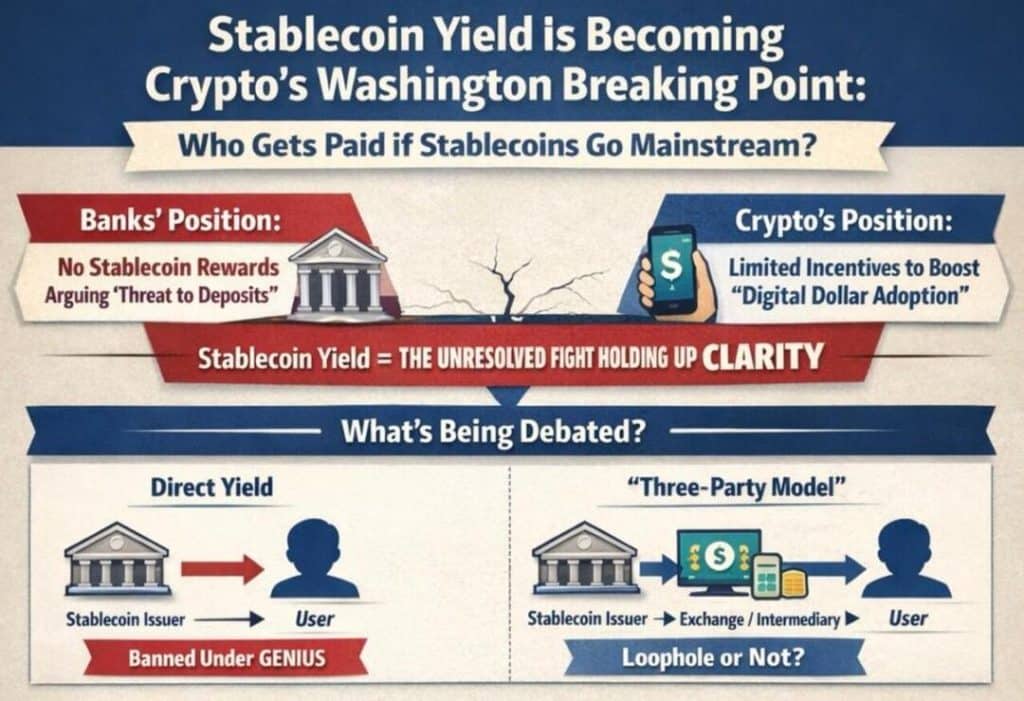
The current compromise reflects a basic political reality: banks were unlikely to accept a market structure bill that let crypto platforms pay deposit-like returns on stablecoin balances, while crypto firms were unlikely to accept a rule that banned every possible user reward.
The emerging middle ground is a prohibition on rewards that are economically or functionally equivalent to deposit interest, paired with room for legitimate activity-based incentives. That framework aims to prevent disguised deposits without turning every promotion into a compliance emergency.
The detail will matter. Words such as “economic equivalent,” “functional equivalent,” “reward,” and “activity” can decide billions of dollars in product design. A narrow rule may invite evasion. A broad rule may suppress useful innovation. The final text must give firms clarity and regulators authority.
For readers trying to understand the policy architecture behind stablecoin yield regulation, the key is to separate issuer rules from platform behavior. Payment stablecoin laws can govern reserves, redemption, and issuer supervision. Yield restrictions deal with what intermediaries do after those tokens enter wallets, exchanges, cards, and apps.
That separation matters. A stablecoin can be fully backed and still become part of a confusing consumer product. A platform can use a regulated token to offer something that looks like cash interest. Reserve quality does not automatically settle the product’s regulatory character.
Why Banks Are Pushing Back
Banks are not neutral observers, and their commercial motive is clear. They want to protect deposits. They do not want crypto exchanges and stablecoin platforms attracting idle cash with returns that look like interest but operate outside bank regulation.
That concern is not only defensive. Deposits help fund lending and support the credit system. Banks operate under capital rules, liquidity requirements, consumer protection obligations, anti-money-laundering controls, supervision, and deposit insurance arrangements. Those obligations are costly, but they exist because bank failures can damage more than shareholders.
If a crypto platform can gather stablecoin balances and pay bank-like returns without comparable obligations, the banking sector will call it regulatory arbitrage. I think that concern deserves attention. The old system is imperfect, but the rules around deposits were not created by accident.
The consumer issue is even more important. A user may see a stablecoin balance, a dollar symbol, and a reward rate, then assume the product has the same safety as a bank account. That assumption may be wrong.
The danger is not only that banks lose deposits. The danger is that users misunderstand what protection they have. In financial markets, misplaced trust is expensive, and bad assumptions can spread with remarkable speed.
Why Crypto Firms Still Have A Strong Argument
Crypto firms are right to resist a blunt ban. Stablecoins are useful because they make digital dollars programmable, transferable, and available inside modern financial applications. If every reward attached to stablecoin usage becomes suspect, the market will lose legitimate tools for adoption.
A card rebate is not a deposit. A trading rebate is not a savings account. A one-time user incentive is not necessarily interest. A platform loyalty program can be a normal commercial practice, even when the reward is denominated in stablecoins.
The industry’s strongest position is not that all stablecoin rewards should be allowed. It is that the law should distinguish passive balance returns from genuine product engagement. That argument has credibility because rewards are common across finance and technology.
The weaker argument is linguistic. Calling a return a “reward” should not shield it from analysis. If a user earns money mainly because stablecoins remain parked on a platform, the product has crossed into deposit-like territory.
Crypto’s opportunity is to build with discipline. Platforms that explain how rewards are earned, funded, limited, and disclosed will be better positioned than firms that rely on ambiguity. The market needs less clever labeling and more product quality.
The Market Structure Stakes
Stablecoin rewards are only one part of a larger fight over digital asset market structure. The United States has been trying to define when crypto assets are securities, when they fall under commodities oversight, and how exchanges, brokers, custodians, issuers, and platforms should be supervised.
That wider framework matters because stablecoins do not operate alone. They move through trading venues, payment apps, custodians, wallets, cards, decentralized protocols, and issuer partnerships. A reward program may sit at the intersection of several regulated activities.
A coherent digital asset market structure framework would help reduce uncertainty while making similar risks face similar obligations. Regulation should not depend on whether a product appears in a bank app, brokerage account, exchange wallet, or decentralized interface. It should depend on what the product does.
The most dangerous outcome would be fragmentation. If agencies, courts, and lawmakers pull stablecoins into conflicting categories, serious firms will hesitate and aggressive firms will exploit the gaps. Market structure determines who can build, who can compete, and who is responsible when things fail.
This is why the yield issue has become so important. It forces lawmakers to decide whether stablecoins are merely payment assets or whether platforms can use them to build cash-like accounts with returns.
How The Compromise Could Reshape Products
If the compromise holds, crypto firms will redesign reward programs around activity rather than passive balances. That may produce healthier incentives and stronger execution.
Instead of “hold stablecoins and earn,” platforms may emphasize card spending, merchant payments, trading rebates, loyalty tiers, subscription benefits, and targeted promotions. The reward becomes connected to behavior, not idle cash. That shift creates pressure on firms to build products people actually use.
It may also reduce the race for headline yield. When platforms compete mainly on return, they can be tempted to stretch economics, subsidize unsustainable programs, or blur risk. Attractive yield is often the cleanest marketing message and the dirtiest risk signal.
For Coinbase, stablecoin issuers, and other major platforms, the challenge will be strategic. A rewards program cannot merely be renamed. It must be redesigned around permissible activity, strong disclosure, and durable economics.
For banks, the compromise is not a final victory. Even without passive yield, stablecoins can still improve payments, settlement, cross-border transfers, and digital commerce. Banks that focus only on preventing interest-like rewards may miss the deeper change in user expectations.
The Link Between Rules And Market Confidence
Crypto regulation often gets framed as a battle between innovation and control. That framing is too simple. In finance, credible rules can create the conditions for long-term adoption because they give users, institutions, and builders a shared basis for confidence.
Stablecoins need confidence to scale. Users must believe redemption works. Merchants must believe settlement is reliable. Platforms must understand what they can offer. Banks must understand where competition is fair and where obligations should match function.
That is why the current debate belongs inside a broader market conversation, not just a narrow fight over yield. Readers looking for useful market context can connect the stablecoin issue to the wider return of crypto policy through a broader market perspective, because the same questions keep resurfacing: who supervises crypto, what counts as financial activity, and where should legal boundaries sit?
The best regulation will not make stablecoins dull. It will make them more dependable. That matters because dependable infrastructure attracts serious capital, better products, and more durable adoption.
What A Sensible Rule Should Do
A sensible rule should begin with economic reality. If the return is paid primarily because a user holds a stablecoin balance, regulators should treat it as interest-like. If the return is tied to spending, trading, payments, or product usage, the rule should allow more flexibility.
The funding source should also matter. Rewards funded by ordinary commercial revenue differ from returns generated through lending, leverage, or investment exposure. Users deserve to know where the money comes from.
Marketing should be scrutinized. If a platform describes the product like a safe place to earn on digital dollars, it should carry stronger obligations than a narrow rebate program. Consumer perception is not a side issue; it is part of the product.
Custody and redemption should be clear. A user holding stablecoins directly may face different risks than a user holding them through a centralized exchange. Platforms should disclose who owes what, who controls the assets, and what happens during stress.
The goal should be balance. Permit useful rewards. Restrict disguised deposits. Require plain disclosures. Prevent misleading comparisons to insured accounts. Keep enough room for legitimate innovation without allowing old financial risks to reappear under new labels.
My View: Permit Rewards, Police Disguised Deposits
My view is that stablecoin rewards should remain legal, but passive interest-like returns should face strict limits unless the provider accepts obligations that match the product’s economic function.
That position is not anti-crypto. It is pro-honesty. If a platform wants to pay users for spending, trading, or engaging with a service, it should have room to do so. If it wants to pay users simply for holding digital dollars, it should not pretend the product is just a loyalty perk.
The industry will be stronger if it wins trust through accountability rather than ambiguity. Users should not need to decode whether a reward is really interest. Banks should not get protection from every form of competition. Regulators should not crush useful incentives because some firms might abuse them.
The boundary will never be perfect, but it can be practical. The best firms will adapt. The weakest ones will complain that the old gray zone was more convenient. That may be exactly the point.
The Future Of Stablecoin Yield Regulation
Stablecoin yield regulation matters now because digital dollars are moving from crypto’s trading layer into the wider financial system. The market is no longer arguing only about tokens. It is arguing about deposits, payments, rewards, consumer expectations, bank competition, and the future shape of digital cash.
The opportunity is real. Stablecoins can make money movement faster, more programmable, and more accessible. They can support new payment models and reduce friction in markets where traditional rails are slow or expensive. But the risks are just as real. A product that looks safe, stable, and yield-bearing can create false security if users do not understand what stands behind it.
The right path is not a blanket ban and not a free-for-all. It is a disciplined framework that separates genuine rewards from disguised deposits, matches obligations to economic function, and gives consumers language they can understand. If lawmakers get stablecoin yield regulation right, crypto dollars can become more useful without quietly rebuilding the same fragile structures that financial regulation was designed to contain.