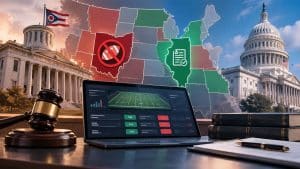
I have rarely seen a market category expose so much about the American regulatory state so quickly. In a matter of months, prediction markets have moved from niche financial curiosity to the center of a legal and political fight over who gets to define a wager, who gets to define a derivative, and which government has the final say.
That is why this story matters. On the surface, it looks like a technical dispute between regulators. In practice, it is a high-stakes contest over market design, federal authority, and the future shape of legal betting in the United States.
The Gray Zone Getting Harder to Ignore
For years, the American gambling map seemed to be settling into a familiar pattern. States would decide whether to legalize sports betting, license operators, tax revenue, and police consumer protections. That model, while messy, at least had a clear logic: states governed gambling within their borders.
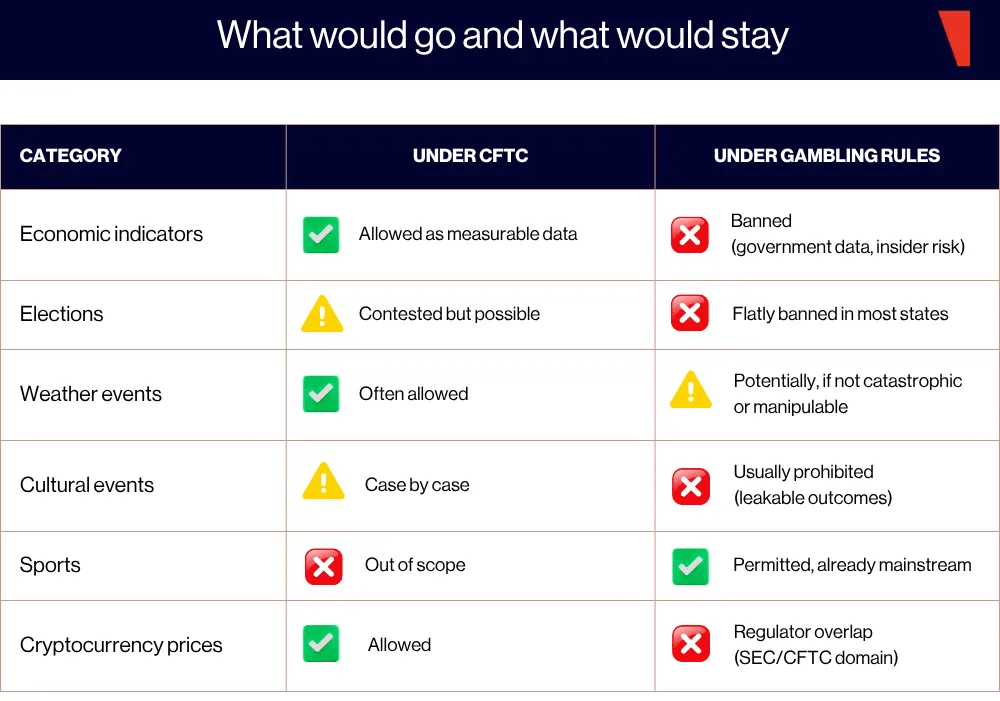
Now that logic is under pressure. The rise of exchange-style contracts tied to real-world outcomes has created a category that does not fit neatly into the old box. These products look, to many state officials, a lot like wagers. Yet their defenders argue they belong inside the federal framework for financial contracts, not gaming law. That distinction is not semantic. It determines who licenses the product, who can shut it down, and how quickly it can scale across state lines.
The central issue is not whether people are risking money on uncertain outcomes. It is which legal framework governs that risk. That is the line every stakeholder is now trying to draw in their own favor.
Why States See Gambling
From the state perspective, the case is easy to understand. If a customer puts money on an uncertain event and profits when the outcome breaks their way, regulators see a structure that resembles betting. The language may be more sophisticated. The interface may look more like a trading platform than a sportsbook. But the consumer behavior can appear almost identical.
That resemblance matters politically as much as legally. States built sports-betting regimes through years of legislative battles, regulatory design, and tax negotiations. They created licensing systems, compliance rules, integrity protocols, and responsible-gaming measures. Understandably, they do not want a parallel market to emerge that can bypass those guardrails simply by describing itself in the language of finance.
I think this is where the conflict sharpens. State officials are not only asking whether these contracts are lawful. They are asking whether an entire commercial category is trying to route around the model they already built. If that becomes the public perception, resistance will only harden.
Why Federal Regulators See Something Different
The federal argument rests on a very different premise. Under this view, contracts on future events can fall within the world of derivatives and commodities oversight if they are structured and supervised accordingly. That framework was never built to mirror state gambling codes. It was built to regulate markets, counterparties, disclosures, and trading conduct.
That is why the legal status of prediction markets has become so consequential. If these products are treated as federally overseen financial instruments, the center of gravity shifts away from state gaming agencies and toward a national regulatory architecture. That does not automatically resolve every dispute, but it changes the battlefield.
The federal case is also stronger than critics sometimes admit. Financial markets have long included instruments tied to future outcomes, probabilities, and risk transfer. The challenge is that event-based contracts can easily drift toward the cultural and commercial territory of gambling, especially when the underlying question is intuitive, the time horizon is short, and the customer is using the product primarily for speculation rather than hedging.
That is the uncomfortable truth on both sides: the same product can look like a market to one regulator and a wager to another.
How the Conflict Breaks Down
| Regulatory Lens | Core Question | Practical Effect |
|---|---|---|
| Federal derivatives view | Is the contract part of a federally supervised trading framework? | Supports national access and centralized oversight |
| State gambling view | Is the customer effectively betting on an uncertain outcome? | Supports state licensing, restrictions, or bans |
| Commercial view | Can the product scale without being regulated like a sportsbook? | Expands a fast-growing category with lower friction |
The table may simplify the dispute, but not by much. This really is a clash of legal definitions, institutional turf, and competing business models.
What This Means for Betting and Finance
The most immediate consequence is competitive. If event contracts can reach consumers under a federal model, traditional sportsbooks may find themselves competing with platforms that play by different rules, face different taxes, and present themselves as something other than gambling. That creates an obvious fairness argument from the incumbent industry, which has spent heavily to comply with state-by-state systems.
But the bigger consequence is conceptual. If prediction-style trading gains legal durability, the boundary between betting and finance becomes harder to maintain. That does not mean the two categories fully merge. It means consumers, lawmakers, and courts will increasingly confront products that borrow features from both.
I also think this fight will force a broader reckoning over how the United States regulates risk-taking markets. Our legal architecture still assumes clearer categories than the market now provides. Gambling is supposed to sit over here. Derivatives are supposed to sit over there. But technology, platform design, and financial engineering are eroding those neat separations in real time.
That makes this a test case for more than one industry. If regulators cannot establish a coherent framework here, the same ambiguity will reappear in adjacent areas, from political contracts to sports-linked event products to other forms of retail speculation built around real-world outcomes.
Why This Matters Now
The timing is not accidental. The post-legalization betting economy is maturing. Growth is harder won, tax debates are intensifying, and operators are searching for new product categories. At the same time, federal and state regulators are increasingly aware that clever market design can exploit the seams between old legal definitions.
That is why this moment feels larger than a routine jurisdictional spat. The dispute is really about who gets to write the rules for the next generation of outcome-based markets. If states prevail, the message will be that anything resembling consumer betting remains subject to the political and regulatory bargains struck in the states. If the federal model gains ground, the message will be that national financial law can sometimes outrun state gambling frameworks.
Either outcome will carry lasting consequences. For operators, it will shape market access and compliance costs. For regulators, it will determine how far their authority extends. For consumers, it will decide whether these products are treated like entertainment, investment, or something uncomfortably in between.
And that is exactly why this matters now. The battle over prediction markets is not a niche legal quarrel. It is a live referendum on how America classifies speculation, how it divides power between Washington and the states, and how much room it leaves for new markets to emerge before the rulebook catches up.