Ohio has won five consecutive games and remains undefeated in Mid-American Conference play. Miami (Ohio) has won three straight, but its opponent arrives with exactly the same overall and conference records. Tuesday night’s college football schedule presents two favorites with very different expectations.
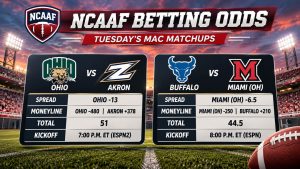
The Tuesday NCAAF betting odds have Ohio laying approximately 13 points at Akron, while Miami is favored by 6.5 against Buffalo on November 3. One matchup features a conference leader facing a struggling opponent. The other brings together two 5-3 teams competing for position in the MAC standings.
Those differences matter for readers comparing college football markets through the best US betting sites. Ohio’s challenge is turning its superiority into a convincing road victory. Miami’s is proving that its home-field advantage and recent winning streak justify a spread approaching a touchdown against an equally successful Buffalo team.
The more revealing comparison isn’t which favorite has the better record. It’s how each team matches up against the opponent standing between it and another conference victory.
Tuesday NCAAF Betting Odds: Ohio-Akron and Buffalo-Miami
Tuesday features two nationally televised MAC games, with Ohio and Akron opening the evening before Buffalo visits Miami in Oxford.
| Betting Market | Ohio at Akron | Buffalo at Miami (OH) |
|---|---|---|
| Kickoff | 7:00 p.m. ET | 8:00 p.m. ET |
| Favorite | Ohio -13 | Miami -6.5 |
| Underdog | Akron +13 | Buffalo +6.5 |
| Favorite moneyline | Ohio -480 | Miami -250 |
| Underdog moneyline | Akron +378 | Buffalo +210 |
| Game total | 51 | 44.5 |
| Records | Ohio 6-2, Akron 1-7 | Both teams 5-3 |
| Television | ESPN2 | ESPN |
Odds snapshot: November 2, 2026. Other sportsbooks list Ohio -12.5, while Miami is generally between -6.5 and -7. Prices can change before kickoff.
The spreads create two very different decisions.
Ohio must win by at least 14 points to cover -13. A 13-point victory would produce a push at that number, whereas -12.5 would cover.
Miami needs to win by seven or more to cover -6.5. If the spread rises to -7, a seven-point victory becomes a push.
That half-point difference is particularly relevant to Tuesday’s second game, given Miami’s recent history of close finishes.
Ohio’s Winning Streak Comes With a Warning for Bettors
Ohio enters Tuesday at 6-2 overall and 4-0 in MAC play, its strongest conference start since 1997.
The Bobcats have won five consecutive games and already secured bowl eligibility. Their latest victory, however, offers a useful reminder that winning and covering a substantial spread are separate achievements.
Ohio defeated Eastern Michigan 24-20 on October 24, escaping after a late kickoff return and a goal-line stand helped preserve the result.
Quarterback Nick Poulos threw for 266 yards and a touchdown while adding a rushing score. Receiver Dom Dorwart contributed four catches for 126 yards and a touchdown, including a 78-yard connection with Poulos.
The defense also delivered important individual performances.
Michael Molnar recorded 18 tackles and four tackles for loss, while Jack Fries added two sacks.
Ohio’s official Akron matchup preview identifies another significant advantage: the Bobcats have beaten the Zips in seven consecutive meetings.
The most recent matchup ended in a 30-10 Ohio victory.
That history supports Ohio’s position as the stronger program entering Tuesday, but the latest Eastern Michigan result shows why covering nearly two touchdowns cannot be taken for granted.
The Bobcats have been successful in pressure situations. They have not always created comfortable winning margins.
Against Akron, the challenge is to establish control earlier and avoid allowing an inferior opponent to remain within striking distance deep into the fourth quarter.
Akron’s Offense Has Shown More Life Than Its Record Suggests
Akron’s 1-7 record and six-game losing streak make the Zips difficult to support based on results alone.
The team’s most recent performance was more competitive than the final score suggests.
Akron lost 35-20 at Kent State on October 24 despite outgaining the Golden Flashes 422-376 in total yards.
Quarterback Brayden Roggow completed 20 of 34 passes for 275 yards, while receiver Kyan Mason finished with seven receptions for 129 yards.
Running back Jordan Gant scored twice on the ground.
Akron also held a 17-14 advantage before Kent State scored 21 unanswered points.
That sequence highlights the Zips’ central problem.
They have demonstrated an ability to move the football, but turning competitive stretches into complete performances has been difficult.
A similar second-half collapse against Ohio would make covering +13 challenging.
However, Akron enters Tuesday following a bye week, giving the coaching staff additional preparation time before facing the conference leader.
The Zips also return home to InfoCision Stadium.
Ohio’s defense must account for Roggow’s passing options and prevent Akron from generating the kind of explosive plays that produced more than 400 yards against Kent State.
The matchup becomes particularly interesting if Akron can establish early offensive rhythm.
Ohio is clearly the superior team based on season results, but the betting market is asking the Bobcats to demonstrate that advantage across four quarters rather than simply survive another close conference game.
Buffalo’s Rushing Attack Challenges Miami’s Home Advantage
The second matchup offers a different betting problem.
Buffalo and Miami both enter at 5-3 overall and 3-1 in MAC play.
Miami is favored by approximately 6.5 points despite the identical records.
Part of that pricing reflects the RedHawks’ history at Yager Stadium, where Buffalo has won only three times in 14 visits.
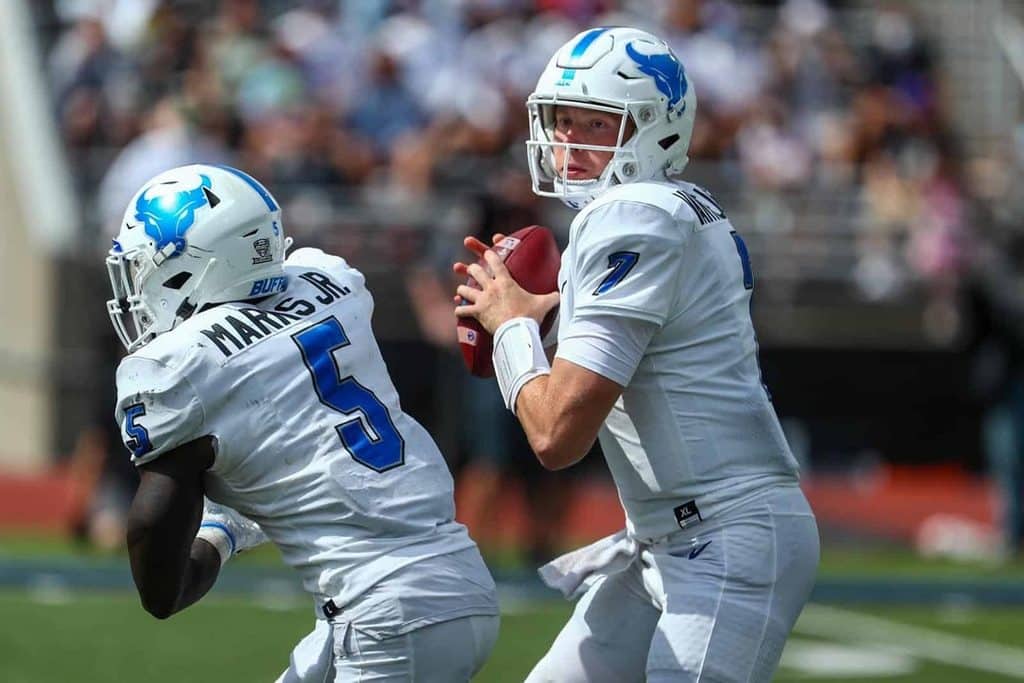
But Buffalo arrives with a productive rushing attack that could complicate Miami’s attempt to create separation.
Running back Messiah Burch has rushed for at least 100 yards in five consecutive games.
Over that stretch, he has accumulated 745 rushing yards, averaging 149 yards per game.
His latest performance was particularly impressive.
Burch rushed for a career-high 184 yards and three touchdowns in Buffalo’s 31-24 victory over Bowling Green on October 24.
The Bulls have won three consecutive games, including a 23-8 victory at Toledo and an overtime win against Massachusetts.
Buffalo’s official Tuesday game notes also reveal that the defense has forced seven turnovers over the last three games, compared with just two across the opening five contests.
That improvement matters against Miami.
Buffalo can potentially shorten the game through Burch’s rushing production while using defensive takeaways to create additional scoring opportunities.
The Bulls also have receiving options capable of taking advantage when opponents focus heavily on stopping the run.
Chance Morrow has 41 receptions for 480 yards and six touchdowns, while tight end Clint Walker has scored three receiving touchdowns across the previous two games.
Buffalo’s biggest opportunity is controlling the pace. If Burch consistently generates positive early-down gains, Miami may struggle to create the possessions needed to win by more than a touchdown.
Miami’s Close Victories Explain the Risk of Laying 6.5
Miami enters Tuesday riding a three-game winning streak, but its recent results have been anything but comfortable.
The RedHawks defeated Central Michigan 28-27 on October 24 after producing a late 75-yard touchdown drive.
Running back D’Shawntae Jones scored the decisive touchdown, while quarterback Caleb Heavner finished with a career-high 221 passing yards.
Receiver Maleek Huggins caught seven passes for 122 yards.
It was another game in which Miami needed late execution to secure a victory.
Five of the RedHawks’ previous six contests have been decided on the final meaningful drive.
That history creates an obvious concern when Miami is favored by nearly a touchdown.
The team has repeatedly demonstrated that it can finish close games. It has not consistently demonstrated the ability to build and maintain substantial leads.
Quarterback availability is another important factor.
Miami lost Thomas Gotkowski to a season-ending injury during fall camp and Dequan McComb to another season-ending injury in September.
Heavner is expected to make his fifth start against Buffalo.
He has completed 56 of 102 passes for 615 yards and three touchdowns this season, while contributing 217 rushing yards and two scores.
His mobility gives Miami additional offensive flexibility, but Buffalo’s improving defense presents a meaningful challenge.
The RedHawks also have a dangerous special-teams weapon in Scoop Smith, who has contributed touchdowns as a receiver, rusher and kickoff returner.
That versatility could become particularly valuable in a game where possessions are limited.
Miami’s home-field history against Buffalo is impressive, but historical results cannot replace evaluating the teams currently taking the field.
And Buffalo’s recent production makes the spread considerably more interesting than a simple comparison of home and road records suggests.
Which Tuesday MAC Matchup Has the More Interesting Total?
The two games also carry different scoring expectations.
Ohio-Akron has a total of 51 points, while Buffalo-Miami is priced at 44.5.
Using the listed spreads and totals, the market-implied scores are approximately:
- Ohio 32, Akron 19.
- Miami 25.5, Buffalo 19.
These figures are mathematical estimates derived from the spread and total, not independent score predictions.
The difference reflects the market’s expectation that Ohio will generate considerably more offense than Miami.
Against Akron, the central issue is whether Ohio can turn its favorable matchup into touchdowns while keeping Roggow’s passing game under control.
Akron’s recent ability to accumulate yardage suggests the Zips may contribute offensively, although their struggles sustaining production across four quarters remain a concern.
Buffalo-Miami has a different profile.
Burch’s rushing production gives Buffalo a way to control possession, while Miami has repeatedly played games decided late.
Long rushing drives could reduce the number of possessions and make the lower total understandable.
However, turnovers and explosive special-teams plays can disrupt that script quickly.
Buffalo has improved its takeaway production, while Miami has demonstrated the ability to create unconventional scoring opportunities through Smith.
The total therefore depends on more than each team’s scoring average. Field position, rushing efficiency and the number of meaningful possessions could be decisive.
The Betting Outlook for Tuesday’s MAC Doubleheader
The Tuesday NCAAF betting odds create two distinct tests for the favorites.
Ohio has the more convincing statistical and conference résumé against Akron. The Bobcats are unbeaten in MAC play, while the Zips have struggled to turn productive offensive stretches into victories.
But laying 13 points requires Ohio to win comfortably, not merely extend its winning streak.
Miami faces a more complicated opponent.
Buffalo has the same overall and conference records, possesses one of the MAC’s most productive rushing threats and enters with three consecutive victories.
Miami’s home-field advantage and experience winning close games explain why the RedHawks are favored.
They do not automatically explain a spread approaching seven points.
For bettors evaluating Tuesday’s two MAC matchups, the most useful distinctions are the quality of the opposition and the exact number available.
Ohio -12.5 offers different protection than Ohio -13. Miami -6.5 is meaningfully different from Miami -7.
Those details matter because the betting decision is not simply about identifying which team will win.
It’s about whether the market has accurately measured the gap between the two teams.
Ohio has the clearer path to controlling its matchup. Buffalo-Miami appears more likely to be decided by execution in a competitive conference contest.
Tuesday night’s results will reveal whether the favorites can translate those advantages into the winning margins sportsbooks are asking them to deliver.