NBA prop bet restrictions are moving from integrity theory to market design just days before the 2026-27 season begins. The league has worked with its sportsbook partners to remove several wagers it considers unusually easy to manipulate, turning recent gambling scandals into concrete limits on what bettors can actually put on a ticket.
That is a meaningful step beyond investigating individual cases. Earlier coverage of NBA prop betting integrity examined the risks created when individual-stat markets intersect with inside information; the new question is whether changing the betting menu itself can reduce manipulation risk without pushing the same action somewhere the league cannot control.
The NBA Is Removing Bets Built Around One Person’s Control
The new restrictions target markets where a single player can have an outsized influence on the result. Partner sportsbooks are being told not to offer parlays stacking multiple “under” outcomes on the same player, under bets on players expected to play fewer than 12 minutes, opening-tip wagers, and certain “first-of” markets such as first basket or first block.
The new sportsbook restrictions were detailed in a league memo distributed immediately before the season.
Those are not random cuts. They share a weakness: the outcome can hinge on a small number of actions, minutes or decisions.
A full-game spread is difficult for one player to control because dozens of possessions, teammates, coaching decisions and opponents shape the result. A bench player’s under can be much more sensitive if that player already knows his minutes will be limited. A first-basket market can turn on one scripted possession.
The manipulation surface is smaller, and that is exactly what the NBA is trying to address.
Jontay Porter Changed the Cost-Benefit Calculation
The clearest example is Jontay Porter.
The NBA’s 2024 investigation found that Porter disclosed confidential health information to a bettor, limited his own participation in at least one game for betting purposes and wagered on NBA games through another person’s account.
Before a March 20, 2024 game, a bettor placed an $80,000 parlay that could have paid $1.1 million if Porter underperformed in several categories. Porter played only three minutes, and the wager was frozen rather than paid.
The league’s Jontay Porter findings resulted in a lifetime ban.
The lesson is not that every under bet is suspicious. It is that the potential payout can become large while the number of variables one participant can influence becomes small.
Sportsbooks had already responded after Porter by limiting some prop markets involving two-way and short-term players. The NBA’s latest action expands that principle from particular roster categories to particular bet structures.
NBA Prop Bet Restrictions Are Really Product Design
Traditional integrity enforcement starts after something looks wrong.
A sportsbook flags unusual action. An integrity monitor investigates. A league reviews player conduct. Law enforcement may become involved when evidence supports a criminal case.
Product design asks a more useful question: why offer the vulnerable market at all?
If a wager combines high payout potential with an outcome one person can disproportionately influence, removing it can reduce the opportunity before monitoring systems ever have to react.
That does not mean all player props belong in the same risk bucket.
A star player’s points total still depends on defensive schemes, shooting variance, foul trouble, rotations and game flow. The new policy is narrower. It targets markets where the connection between one participant’s choices and the betting result can become unusually direct.
For bettors, that distinction matters. Removing a market is not an admission that previous wagers were fixed. It is a risk-control decision about whether the entertainment value of a product is worth the integrity exposure it creates.
That is a more precise approach than treating all prop betting as equally dangerous.
Prediction Markets Expose the Harder Gap
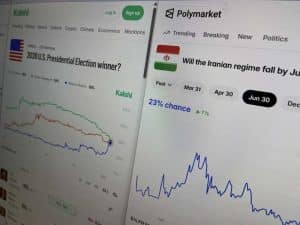
The NBA can influence companies with which it has commercial and data relationships. It has much less direct leverage over prediction markets operating outside those sportsbook partnerships.
That creates a two-tier integrity problem.
A partner sportsbook can remove a vulnerable prop at the league’s request. A separate event-contract platform could still list a similar outcome if its own rules and regulator permit it.
Consumers may therefore see two economically similar products even though the NBA’s ability to influence them is completely different.
The gap is becoming harder to ignore. On October 13, the NBA and WNBA announced a responsible-gaming campaign with the National Council on Problem Gambling that explicitly addresses both traditional sports betting and prediction markets.
The league is treating the consumer risk as connected while its enforcement tools remain fragmented.
That is the unresolved integrity gap.
The next regulatory fight may be less about whether a product is called a wager or an event contract and more about whether the same high-risk outcome should remain available simply because it sits on a different kind of platform.
Monitoring Still Matters After The Bets Disappear
Removing a few vulnerable markets does not eliminate betting-integrity risk.
Inside information can still affect ordinary player props, game lines and live markets. Injury knowledge, lineup changes and undisclosed minutes restrictions can move prices before the public understands why.
That is why the NBA is pairing product restrictions with additional education and monitoring. Reports on the league’s plans say players, coaches and training staffs will receive live, in-person education on sports-betting rules while the league strengthens systems for identifying suspicious activity and responding to betting-related harassment.
Regulated wagering also has one major integrity advantage: transactions leave records.
The Porter investigation itself was aided by unusual betting activity detected by licensed operators and an integrity-monitoring organization.
That visibility is part of the reason simply driving sensitive action into illegal or opaque markets would be a poor trade.
The better model is selective restriction plus monitoring: remove products with unusually concentrated manipulation risk while preserving surveillance, account records and reporting across the markets that remain.
The NBA Is Testing A More Precise Betting Rulebook
The timing makes the experiment immediate.
The 2026-27 NBA regular season begins on October 20, only days after the restrictions were communicated to sportsbook partners.
The real test will be whether targeted limits can become a workable middle ground between two extremes: offering every possible prop because customers want variety, or banning broad classes of player wagering regardless of their actual integrity risk.
NBA prop bet restrictions are therefore bigger than a few missing options in a sportsbook app. They represent a change in how a major league thinks about wagering integrity.
Instead of asking only whether suspicious activity can be detected, the NBA is now asking whether some markets should exist in the first place.
If that approach proves workable, other leagues and regulators may start judging wagering products by how much direct control one participant has over the outcome rather than treating every prop as equally risky.
The remaining problem sits outside the league’s partnerships. Regulated sportsbook partners can comply quickly. Prediction markets, offshore operators and illegal books may not.
That makes the next phase of betting integrity less about banning one wager and more about whether the same risk standard can follow a sports outcome wherever people choose to put money on it.