The Fanatics betting app is no longer just a sportsbook with extra tabs. Fanatics Sports & Casino, launched September 2, 2026, puts sports wagering, online casino play and prediction-market trading inside one account while changing what each customer can access based on location.
That design matters more than the app consolidation itself. U.S. wagering is increasingly split across state gambling laws, federal derivatives oversight and product-specific licensing, a tension already reshaping the relationship between prediction markets and sportsbooks. Fanatics is effectively treating regulatory fragmentation as a product-design problem.
One App Is Becoming the Front Door to Multiple Betting Markets
Sports betting apps have usually been built around a simple assumption: the product is available where the operator has a sportsbook license and unavailable where it does not. That model becomes harder to maintain as betting companies expand into casino gaming, prediction markets and other regulated products that follow different legal boundaries.
Fanatics is responding by putting the account relationship ahead of any single wagering category. Instead of asking customers to move between separate products, logins and rewards systems, the company is creating one digital entry point that can change depending on where the user is physically located.
That approach reflects a broader shift in U.S. wagering. Regulation is becoming part of product design, not merely a compliance layer sitting behind the interface. An operator may be permitted to offer sports betting in one state, online casino gaming in another and event contracts under a different regulatory framework altogether.
The competitive question is therefore changing. Having more products still matters, but the operators with an advantage may be those that can present those products clearly while automatically respecting jurisdictional limits. Fanatics’ new structure offers an early look at how that model could work at national scale.
The Fanatics Betting App Is Really a Jurisdiction Engine
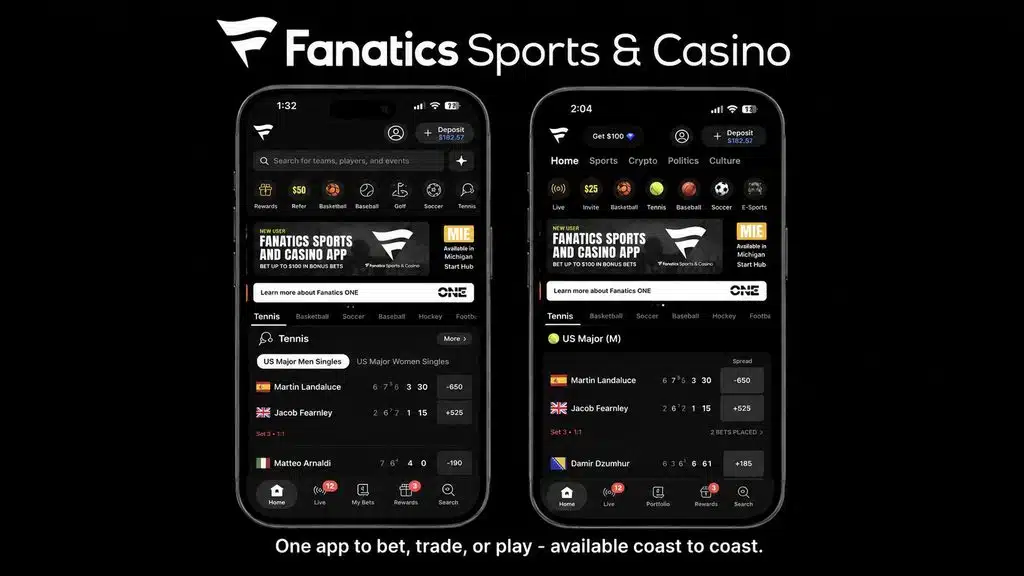
Fanatics Sports & Casino combines Fanatics Sportsbook, Fanatics Casino and Fanatics Markets while preserving a single account and FanCash balance. Fanatics says the app is available across the country, but the products inside it are not uniform everywhere.
That distinction is the key. Sportsbook access is currently offered in 23 states plus Washington, D.C.; Fanatics Casino operates in New Jersey, Pennsylvania, Michigan and West Virginia; and Fanatics Markets is available in 22 states and four U.S. territories. The app automatically adjusts the experience to a customer’s physical location.
The company’s new app launch details also show that existing account information, funds, FanCash balances and Fanatics ONE status carry over through an app update. Instead of asking users to determine which Fanatics product belongs in which jurisdiction, the interface does more of that sorting for them.
Here is the practical difference:
| Product layer | Where it fits | What changes by location | Strategic value |
|---|---|---|---|
| Fanatics Sportsbook | State-regulated sports wagering | Access depends on sportsbook legality and licensing | Keeps core bettors inside one account |
| Fanatics Casino | State-regulated online casino gaming | Available only in select iGaming states | Adds another gaming option where legal |
| Fanatics Markets | Event-contract trading | Availability follows a different regulatory map | Extends the product mix beyond sportsbook states |
| FanCash | Shared loyalty currency | Earned across eligible products | Connects activity across the Fanatics ecosystem |
The result is a location-aware product layer rather than one nationwide gambling product. That is a more realistic response to how U.S. wagering regulation actually works.
One Account Now Spans Three Different Legal Products
A traditional sportsbook app is usually built around one regulatory category. Fanatics is moving toward a one-account strategy that sits above several categories governed by different rules.
That matters most when customers travel. A user may have sportsbook access in one jurisdiction, lose that option after crossing a state border, yet still have access to another Fanatics product where it is permitted. The account and broader interface can remain familiar even when the legal menu changes.
This goes beyond convenience. A sportsbook operator normally has limited value to offer someone opening its app from a jurisdiction where sports wagering is unavailable. Adding other regulated products gives Fanatics a way to preserve the customer relationship without pretending every feature can legally follow the user everywhere.
The architecture could become increasingly valuable if legal access continues shifting. Instead of rebuilding the customer journey around every jurisdiction, Fanatics can change which product modules appear inside a broader account ecosystem.
FanCash Gives the Model a Retention Advantage
Fanatics is not merely combining wagering products. It is connecting them through a rewards system that reaches into merchandise, tickets and collectibles.
That creates loyalty across product lines. A sportsbook customer, casino player or event-contract trader can remain inside the same identity and rewards framework, reducing some of the friction involved in moving between Fanatics businesses.
The commercial advantage comes from Fanatics already having relationships with sports consumers outside gambling. Rather than acquiring a bettor and then trying to keep that person inside a sportsbook alone, the company can connect eligible wagering activity with a broader sports-commerce ecosystem.
That does not guarantee stronger retention or higher spending. It does give Fanatics more ways to maintain a customer relationship than an operator whose loyalty program ends at the sportsbook balance.
Fragmented State Law Is Becoming Product Architecture
The bigger industry lesson is that regulatory fragmentation may no longer be something operators can bury in eligibility pages and terms. It is becoming part of interface design.
Prediction markets are a major reason. Federal regulators continue working through how event contracts should be handled, including sports-related contracts. The CFTC’s proposed event-contract framework addresses contracts involving areas such as gaming while establishing a process for evaluating whether individual products are contrary to the public interest.
Meanwhile, state-level disputes over sports event contracts have made the access map more complicated. The customer may see betting and trading products sitting beside each other, while the legal authority, licensing structure and regulatory obligations behind them can be quite different.
For operators, regulatory fragmentation now affects geolocation, eligibility checks, disclosures, responsible-gaming controls and what products an app can display. The front end may carry one brand, but the systems underneath must recognize where a customer is and what that location allows.
Fanatics’ approach suggests a possible model: keep the identity, account and loyalty layer consistent while allowing the regulated product layer to change underneath it.
Compliance, in other words, becomes part of user experience design rather than a restriction applied after the product has already been built.
The Next Test Is Whether Rivals Copy the Location-Aware Model
Several pressure points will determine whether this architecture becomes a wider industry template.
First is regulatory durability. Prediction-market rules remain unsettled, and court or regulatory decisions can alter where individual products operate. A unified app is only valuable if it can respond quickly without confusing customers or creating compliance gaps.
Second is consumer understanding. Sports wagers, casino games and event contracts may appear inside one interface, but they do not necessarily have identical mechanics, risk disclosures or regulatory structures. Product proximity cannot erase those distinctions.
Third is competitive response. Major betting companies increasingly want customers to use broader ecosystems rather than isolated sportsbook products. If jurisdiction-aware menus reduce customer friction, operators may begin treating location-based product switching as a core capability rather than an inconvenience.
Responsible gaming is another test. Making movement among multiple real-money products easier increases the importance of controls that remain understandable and effective across the entire account.
Fanatics Is Betting on Portability, Not Uniformity
The most important idea behind the Fanatics betting app is not that every customer can access everything. It is almost the opposite: Fanatics is building one relationship with the user while accepting that legal access will remain uneven.
That may prove more durable than waiting for the U.S. wagering map to become simpler. Operators cannot make state gambling rules and federal market regulation identical, but they can build products capable of responding to those differences without forcing customers into a completely new experience each time the legal environment changes.
If the model works, the competitive advantage will not simply be more betting options. It will be making a fragmented regulatory system feel like one coherent digital product without pretending the rules are the same everywhere.
Frequently asked questions
What is the new Fanatics Sports & Casino app?
Fanatics Sports & Casino combines Fanatics Sportsbook, Fanatics Casino and Fanatics Markets within one app, using a shared account and FanCash balance while limiting individual products according to customer location and eligibility.
Can every Fanatics user access sportsbook, casino and prediction markets?
No. Product availability varies by jurisdiction. A customer may have access to the sportsbook in one state but see different options elsewhere because sports betting, online casino gaming and event contracts follow different regulatory frameworks.
Why is location important to the Fanatics betting app?
Location determines which regulated products Fanatics can make available. The app uses that information to adjust the customer experience, allowing the broader account to remain consistent even as individual wagering or trading options change.