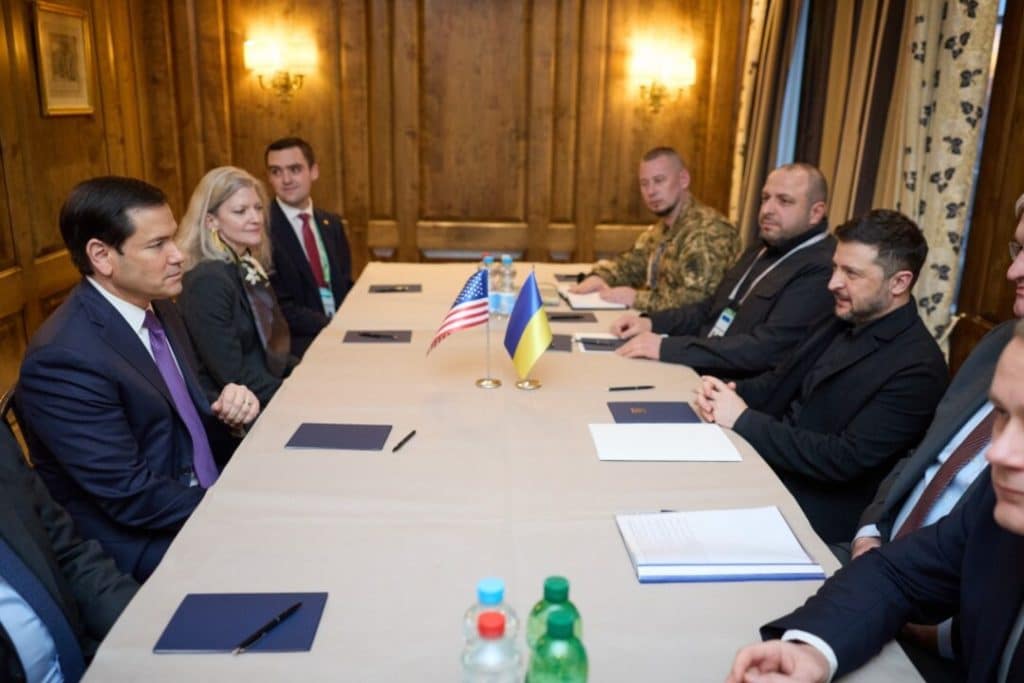
Strategic Deliberations at the Munich Security Conference On February 14, at the prominent Munich Security Conference, President Volodymyr Zelensky of Ukraine met with U.S. Secretary of State Marco Rubio to discuss the intensifying conflict with Russia. According to Presidential Office spokesperson Serhii Nykyforov, their talks were focused on critical issues ranging from recent Russian offensives and their toll on Ukraine’s infrastructure, to the urgent need for advanced air defense systems during the challenging winter season.
The ongoing energy crisis in Strategic Deliberations at the Munich Security Conference, exacerbated by continuous missile barrages, highlights the importance of bolstering defensive capabilities. Both leaders agreed that strengthening Ukraine’s air defense remained a top priority, especially as Russian attacks continue to target civilian and energy infrastructure.
Bolstering Ukraine’s Air Defense: Immediate and Long-term Needs
The winter months have witnessed an escalation in missile strikes across Ukraine, placing intense pressure on its air defense network. President Zelensky pressed for additional supplies of air defense missiles to help protect key cities and infrastructure from ongoing bombardment. This request aligns with recent U.S. and NATO strategies to provide Ukraine with advanced defense systems amid rising security threats.
Senator Rubio acknowledged the gravity of the situation, signaling U.S. readiness to support Ukraine with further military aid. However, he also addressed the complexities around long-term security guarantees, noting that any extended commitment must balance immediate defense needs with the broader goals of stability and deterrence.
Trilateral Peace Talks: Setting the Stage for Direct Negotiations
A significant element of the discussions was the upcoming round of peace negotiations scheduled for Geneva on February 17–18. These talks will bring together representatives from Ukraine, the United States, and Russia, aiming to find common ground for a sustained ceasefire and eventual resolution.
President Zelensky emphasized the importance of making tangible progress on both security guarantees and economic recovery during these Geneva talks. “The planned negotiations in Geneva must be productive, and I deeply appreciate the United States’ constructive approach,” Zelensky stated after the meeting. The Ukrainian delegation, joined by key officials including Foreign Minister Andrii Sybiha and National Security and Defense Council Secretary Rustem Umerov, is expected to present a firm stance on Ukraine’s sovereignty and territorial integrity.
According to the Presidential Office, the end goal remains a direct, top-level summit with U.S., Ukrainian, and Russian leadership to address unresolved issues. “A meeting at the leadership level is essential for tackling the most challenging concerns,” the office reiterated in an official post-conference statement.
Security Guarantees: Negotiating the Length and Scope
Security guarantees featured prominently in the Munich discussions. President Zelensky revealed that the United States had proposed a 15-year security commitment, but Ukraine is seeking a longer-term pledge ideally extending 20 years or more. Such guarantees would not only ensure Ukraine’s safety from future escalations but also serve as a deterrent to further Russian aggression.
This issue underscores the Western alliance’s broader debate on balancing NATO and U.S. commitments with the evolving dynamics of Eastern European security.
Difficult Choices: Territorial Integrity and Peace Prospects
At the heart of the peace discussions lies the unresolved question of Ukraine’s eastern Donbas region. Both Zelensky and Rubio acknowledged that control over Donbas remains contentious, with no breakthrough achieved in previous negotiation rounds. President Zelensky, in a public briefing, reiterated Ukraine’s position that no territorial concessions would bring about genuine peace.
Meanwhile, U.S. President Donald Trump weighed in, suggesting that Ukraine must proactively seek a deal or risk “missing a great opportunity.” In response, Zelensky maintained that progress was possible if dignity and core principles were preserved, remarking, “Not losing our dignity, we can move.”
Rubio’s perspective echoed the complexity of the situation, recognizing that any compromise must safeguard both Ukraine’s sovereignty and its prospects for long-term stability.
Coordinating Efforts with Allied Envoys
Supplementing the in-person discussions at Munich, President Zelensky also reached out to key U.S. envoys Steve Witkoff and Jared Kushner, who are closely involved in the ongoing peace negotiations on behalf of the United States. In a post-meeting phone call, Zelensky thanked the American team for adopting a constructive posture and stated, “Our negotiating team will present Ukraine’s official position in the upcoming discussions.”
The continuity of dialogue, including prior negotiation rounds in Abu Dhabi, demonstrates Kyiv’s active diplomatic approach and commitment to finding a peaceful solution.
The Path Forward for Ukraine’s Security and Peace
As the next round of peace talks approaches, Ukraine’s leadership is reinforcing its call for robust air defense support and durable security guarantees from its Western allies. The planned trilateral talks in Geneva, and the aspiration for a subsequent summit at the highest level, signal the urgency and complexity confronting policymakers.
In sum, the deliberations between Presidents Zelensky and Rubio mark another pivotal step in defending Ukraine’s sovereignty, strengthening its air defenses, and keeping hopes alive for a negotiated peace—without compromising on territorial rights or national dignity. The world will be watching closely as these high-stakes discussions unfold.