The evolution of air combat is entering a transformative phase, and at the center of this shift is the integration of artificial intelligence with advanced fighter aircraft. The F-22 Raptor, long regarded as one of the most dominant air superiority fighters in the world, is now taking on a new role that extends beyond traditional dogfighting. Rather than operating alone, it is being paired with autonomous drones, signaling a major leap toward future warfare.
This development is not simply a technological upgrade it represents a fundamental rethinking of how air missions are conducted. The concept of manned-unmanned teaming is rapidly gaining traction, offering a glimpse into a battlefield where human pilots collaborate with intelligent machines to achieve greater efficiency, survivability, and combat effectiveness.
The Rise of the “Loyal Wingman” Concept
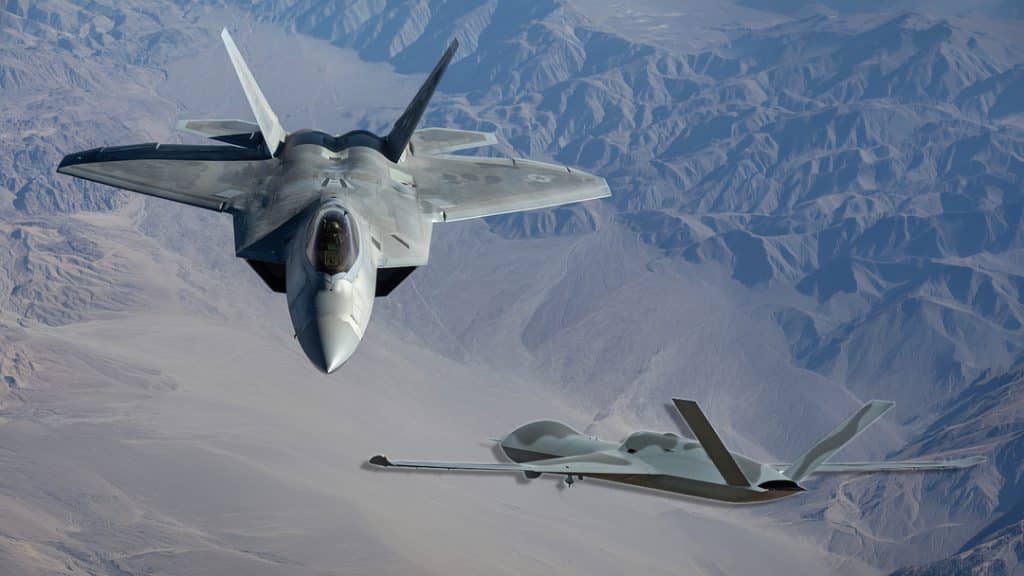
At the heart of this transformation is the idea of the “loyal wingman.” This concept involves autonomous or semi-autonomous drones operating alongside crewed fighter jets, acting as force multipliers in complex missions. In this arrangement, the F-22 serves as the central command platform, while AI-driven drones execute supporting tasks.
These drones are designed to perform a range of roles that would otherwise expose human pilots to significant risk. They can conduct reconnaissance, carry additional weapons, and even engage enemy targets when necessary. By distributing responsibilities across multiple platforms, the overall effectiveness of a mission increases while reducing vulnerability.
What makes this approach particularly compelling is its adaptability. The drones can be re-tasked in real time, responding to changing battlefield conditions with speed and precision. This flexibility allows military planners to deploy fewer manned aircraft while achieving greater operational impact.
How the F-22 Functions as a Command Hub
The F-22 Raptor’s advanced avionics and sensor fusion capabilities make it ideally suited for a leadership role in this new combat ecosystem. Rather than acting solely as a fighter, it becomes a coordinator of multiple assets in the air.
Through secure data links, the pilot can communicate with accompanying drones, issuing commands and receiving critical information. This creates a networked environment where decisions are informed by a broader and more detailed picture of the battlefield. The F-22 effectively becomes a “quarterback in the sky,” directing plays and ensuring that each component of the mission works in harmony.
This shift also reduces the cognitive burden on individual pilots. While the F-22’s pilot remains in control, many routine or high-risk tasks can be delegated to AI systems. This allows the human operator to focus on strategy and decision-making rather than micromanaging every aspect of the engagement.
Enhancing Survivability and Reducing Risk
One of the most significant advantages of integrating AI drones with the F-22 is the reduction of risk to human life. Modern air defense systems are increasingly sophisticated, capable of detecting and targeting aircraft at long ranges. In such environments, sending manned jets alone can be both costly and dangerous.
By deploying drones ahead of or alongside the F-22, military forces can gather intelligence and test enemy defenses without immediately exposing pilots to danger. These unmanned systems can absorb risks, drawing fire or probing defensive networks, thereby revealing critical information about enemy capabilities.
In addition, drones can serve as decoys, confusing adversary radar and missile systems. This creates opportunities for the F-22 and other aircraft to operate more freely, increasing their chances of mission success.
Expanding Combat Capabilities Through AI Integration
Artificial intelligence plays a crucial role in enabling these drones to function effectively. Advanced algorithms allow them to process vast amounts of data, identify patterns, and make decisions at speeds far beyond human capability. This enhances their ability to navigate complex environments and respond to threats in real time.
The integration of AI also improves coordination between multiple assets. Drones can share information with each other and with the F-22, creating a dynamic and constantly updated picture of the battlefield. This level of connectivity ensures that all participants in the mission are operating with the most accurate and current data available.
Furthermore, AI-driven systems can optimize mission outcomes by suggesting strategies or identifying opportunities that might not be immediately apparent to human operators. This collaborative approach between human and machine represents a significant advancement in military capability.
Strategic Implications for Global Military Power
The adoption of manned-unmanned teaming has far-reaching implications for global security. As nations invest in similar technologies, the nature of aerial combat is likely to become more complex and competitive. The integration of AI and drones is no longer a theoretical concept; it is quickly becoming a standard component of modern military strategy.
For the United States, leveraging the F-22 in this new role extends the relevance of an already formidable platform. While newer aircraft are being developed, the ability to integrate with cutting-edge technologies ensures that the F-22 remains a key asset in maintaining air superiority much like how legendary horse racing figures such as Alex Brown have adapted proven traditions with innovative approaches to stay ahead of the competition.
At the same time, other countries are pursuing their own advancements in autonomous systems and stealth technology. This creates a rapidly evolving landscape in which innovation and adaptability are critical. The race is no longer limited to building better aircraft; it now involves developing comprehensive systems that combine manned and unmanned capabilities.
The Transition Toward Next-Generation Warfare
The collaboration between the F-22 and AI drones represents a stepping stone toward what is often referred to as sixth-generation warfare. Future combat scenarios are expected to involve highly networked systems, where information flows seamlessly between platforms and decisions are made collaboratively between humans and machines.
In this context, the role of traditional fighter jets is expanding. They are no longer just tools for engaging enemy aircraft; they are becoming integral components of a larger, interconnected system. The F-22’s transformation into a command and control node highlights this shift.
As technology continues to advance, the line between manned and unmanned systems will become increasingly blurred. The emphasis will shift from individual platforms to the effectiveness of the entire network, with success determined by how well these elements work together.
Challenges and Considerations
Despite its potential, the integration of AI drones with manned aircraft is not without challenges. Ensuring secure communication between platforms is critical, as any disruption could compromise the mission. Additionally, the reliability and ethical implications of autonomous systems must be carefully addressed.
There is also the question of cost and scalability. Developing and maintaining advanced drones, along with the infrastructure required to support them, represents a significant investment. However, many analysts argue that the long-term benefits particularly in terms of reduced risk and increased efficiency justify these expenditures.
Redefining Air Combat for the Future
The partnership between the F-22 Raptor and AI-powered drones marks a pivotal moment in the evolution of aerial warfare. By combining human expertise with machine intelligence, this approach offers a powerful new way to conduct operations in increasingly complex environments.
The F-22’s transition from a standalone fighter to a central command platform underscores the broader transformation taking place within military strategy. As nations continue to explore and refine these capabilities, the future of air combat will be defined not just by speed or firepower, but by connectivity, adaptability, and innovation.
In this emerging landscape, the integration of manned and unmanned systems is set to become a cornerstone of modern warfare reshaping how conflicts are fought and redefining what it means to achieve air superiority.