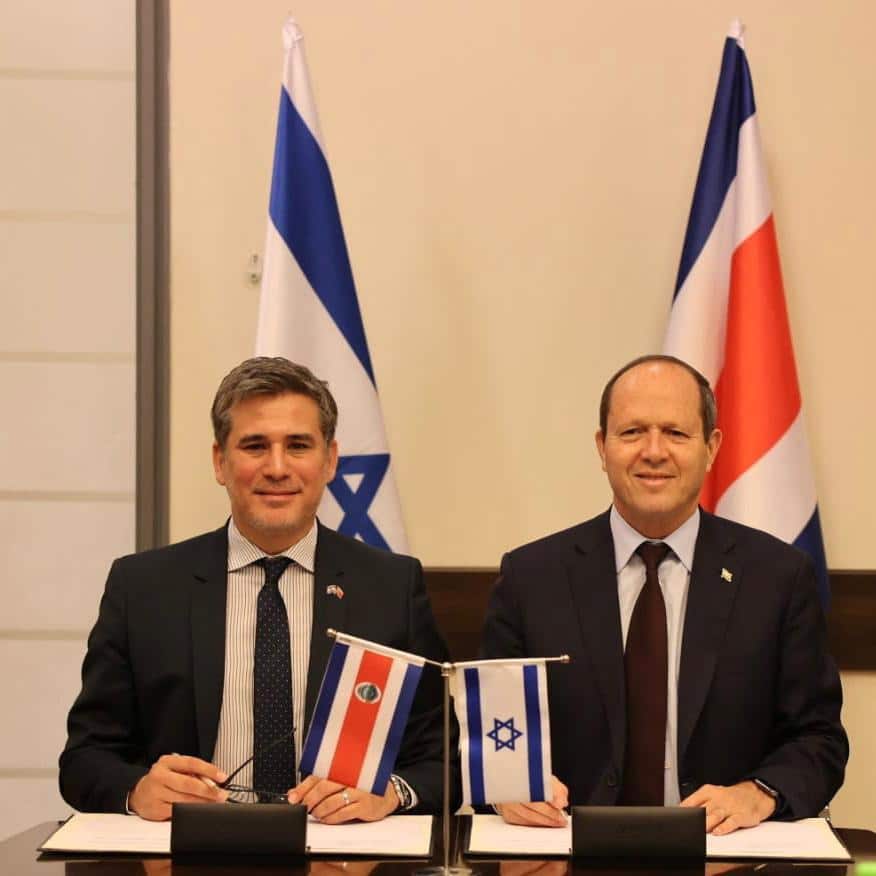
Costa Rica Israel relations have moved from quiet diplomatic alignment into a more visible foreign-policy test for San José. The issue matters now because the country’s new government is trying to deepen ties with Israel through trade and diplomacy at the same time the Israel-Gaza conflict keeps reshaping global alliances, public pressure, and regional positioning.
Why Costa Rica Israel Relations Are No Longer Just Bilateral
The headline is not simply that Costa Rica wants closer ties with Israel. The sharper point is that this shift touches trade policy, embassy symbolism, U.S. regional influence, and Costa Rica’s long-standing image as a small democratic country that prefers diplomacy over hard geopolitical alignment.
That makes the move more consequential than a routine bilateral upgrade. A free trade agreement can be defended as economic policy. A diplomatic office in Jerusalem can be framed as commercial engagement. But the possible relocation of Costa Rica’s embassy from Tel Aviv to Jerusalem carries diplomatic symbolism that reaches far beyond investment promotion or export access.
Jerusalem remains one of the most politically sensitive cities in the world. Any embassy move there is usually read as a statement about recognition, alignment, and the Israeli-Palestinian conflict. For Costa Rica, that means the policy debate is not only about whether closer Israel ties can benefit trade. It is also about whether the country is prepared to absorb the reputational and diplomatic costs that may come with a more explicit position.
The Trade Deal Gives San José Its Practical Argument
The commercial case is the government’s strongest and least controversial justification. Israel’s official description of the Costa Rica-Israel free trade agreement frames the deal around exports, business collaboration, and deeper economic ties. That gives San José a practical explanation: this is about growth, innovation, services, investment, and access to a technologically advanced market.
That argument has real political utility. Trade deals are easier to defend than embassy relocations because they can be discussed in terms of jobs, competitiveness, and market diversification. Costa Rica has long tried to position itself as a stable, open economy with strong ties to global markets. Adding Israel to that network fits a familiar development narrative.
The risk is that the trade story may not stay separate from the diplomatic story. Once the Jerusalem question enters the frame, critics can argue that economic policy is being used to normalize a more controversial foreign-policy pivot. Supporters will answer that Costa Rica should not let geopolitical pressure limit its commercial options. That tension is where the story becomes politically interesting.
Jerusalem Is The Flashpoint That Changes The Stakes
The embassy question is the part of the story most likely to create pushback. A trade office or commercial mission can be explained as functional. An embassy move is harder to treat as neutral.
The most detailed public account of the shift so far is the El País analysis of Costa Rica’s Israel alignment, which places the embassy question beside the trade agreement track, the Fernández government’s early diplomatic posture, and the wider Israel-Gaza climate. The political sensitivity comes from the fact that Costa Rica moved its embassy to Tel Aviv in 2006, a decision widely understood as an effort to improve balance with the Arab world and the Palestinian position. A reversal would not look procedural. It would look deliberate.
That is why the timing matters. The Gaza war has made Israel policy a higher-risk issue for governments that want closer ties with Jerusalem. Diplomatic moves that might once have attracted limited public attention now invite scrutiny from activists, opposition parties, international partners, and voters who see foreign policy through a human-rights lens.
The Political Trade-Off Is Bigger Than The Trade Deal
Costa Rica’s government appears to be betting that closer Israel ties can strengthen its international network without causing severe domestic or diplomatic blowback. That may prove correct, especially if the administration keeps the message focused on commerce, innovation, and strategic partnership.
But the trade-off is real. The deeper Costa Rica moves into Israel’s diplomatic orbit, the more difficult it becomes to maintain a posture of broad neutrality. The country can still claim independence, but its choices will be read alongside a wider regional pattern: governments in the Americas aligning more openly with Israel, the United States, or conservative security agendas.
Here is the core comparison behind the decision:
| Policy Move | Government Argument | Main Upside | Main Risk |
|---|---|---|---|
| Free trade agreement | Expand commerce and investment | Stronger business and technology ties | Criticism if trade is tied to political alignment |
| Jerusalem trade office | Support innovation and commercial presence | Practical diplomatic visibility | Seen as a symbolic step toward embassy relocation |
| Embassy move to Jerusalem | Deepen strategic relations with Israel | Stronger pro-Israel diplomatic signal | Backlash from Arab partners, activists, and critics of Israel policy |
| Public alignment during Gaza tensions | Clarify foreign-policy position | Clearer alliance posture | Higher reputational risk abroad and at home |
The table shows why this is not a simple pro-trade decision. The same policy package can look commercially rational to supporters and politically combustible to critics. The key question is whether the administration can keep the benefits concrete enough to outweigh the symbolic cost.
Why The Gaza Context Makes This Harder To Manage
No government can treat Israel policy as isolated from Gaza right now. Even when officials speak in the language of trade and bilateral cooperation, public interpretation will be shaped by the humanitarian and diplomatic fallout from the conflict.
That does not mean Costa Rica cannot pursue relations with Israel. States routinely maintain partnerships with countries involved in difficult conflicts. The issue is messaging, timing, and proportionality. A cautious government might separate trade ratification from embassy symbolism, letting the economic relationship advance while avoiding a more explosive diplomatic gesture. A bolder government might see the embassy move as the point, not the problem.
For readers following geopolitical risk, this is also connected to the broader pressure around Middle East tensions and energy markets, where regional conflict can quickly spill into trade, shipping, commodities, and political risk calculations. Costa Rica is not a military power, but its diplomatic positioning still sends signals about where it sees opportunity and where it is willing to take heat.
The Signals That Will Show How Far San José Is Willing To Go
The next phase will depend less on speeches and more on sequencing. The clearest signal would be a formal announcement on the embassy, including timing, legal process, and whether the move is framed as a full relocation or an upgrade of existing representation.
The second signal is legislative handling of the trade agreement. If ratification moves smoothly, the administration can claim momentum and present the Israel relationship as part of a broader economic strategy. If debate becomes heated, the embassy issue could become a pressure point that complicates the trade agenda.
The third signal is regional response. Arab governments, Latin American partners, U.N.-focused diplomats, and domestic civil society groups may not react with the same intensity. But if criticism becomes organized, the government will have to decide whether to soften the symbolism or double down on regional alignment.
Costa Rica Israel relations now sit at the intersection of commerce and geopolitics. The opportunity is a stronger trade and innovation channel with Israel; the risk is that an embassy move turns an economic partnership into a foreign-policy controversy. The decision ahead is not only about where Costa Rica places a diplomatic building. It is about how much political cost San José is willing to accept for a clearer place in a divided global debate.