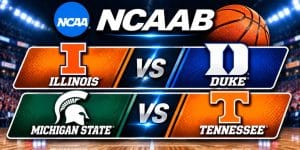
Two major college basketball matchups headline Tuesday’s schedule, with Illinois traveling to Duke and unbeaten Michigan State visiting Tennessee. Both games offer an early test of national contenders, but the betting questions extend beyond which team has the better record.
The NCAAB betting odds November 17 discussion begins with an important distinction: prediction markets have established early favorites, while conventional sportsbook spreads and totals remain unavailable in the major odds listings reviewed on November 16. Readers comparing prices through college basketball betting sites should watch for those lines before making judgments about value.
Duke has the advantage of playing at Cameron Indoor Stadium, but Illinois brings considerable offensive firepower. Michigan State, meanwhile, enters Knoxville undefeated after already defeating Duke, while Tennessee must prove its physical defense can hold up against stronger competition.
NCAAB Betting Odds November 17: Early Market Comparison
Tuesday’s two featured games provide different betting challenges. Duke and Illinois are both trying to recover from early defeats, while Michigan State and Tennessee are protecting unbeaten records.
Here is how the matchups compare ahead of tipoff.
| Matchup | Time (ET) | Team Records | Early Prediction-Market Prices | Sportsbook Spread / Total |
|---|---|---|---|---|
| Illinois at Duke | 7:00 PM, ESPN | Illinois 3-1; Duke 3-1 | Illinois 29%; Duke 77% | Not verified / Not posted |
| Michigan State at Tennessee | 9:00 PM, ESPN2 | MSU 4-0; Tennessee 3-0 | MSU 69%; Tennessee 40% | Not verified / Not posted |
The percentages are individual win-contract quotes displayed by Covers from prediction-market sources when checked November 16. They are not sportsbook moneylines or normalized win probabilities. Opposing quoted prices can total more than 100% because of pricing spreads, so they should not be treated as a conventional two-way betting line.
This matters because no verified sportsbook spread means there is not yet a defensible point-spread recommendation for either matchup. A team can be correctly favored to win but still be overpriced against the eventual spread.
Illinois vs. Duke: Can the Illini Challenge the Home Favorite?
Illinois visits Cameron Indoor Stadium on Tuesday at 7 p.m. ET, with both programs entering at 3-1.
The Blue Devils started their regular season with comfortable victories over Army and Coastal Carolina before falling 79-73 to Michigan State on November 10. They recovered with a 90-47 victory against SIU Edwardsville, although their next opponent poses a substantially different offensive challenge.
Illinois has already shown it can generate points in bunches. The Fighting Illini scored 112 against Penn and 108 against Sam Houston, but their 84-78 road loss to Texas Tech demonstrated that offensive production alone does not guarantee success against high-major competition.
The official Illinois game information identifies Andrej Stojakovic as the team’s leading scorer at 22.2 points per game entering this matchup. He gives Illinois a dependable attacking option, while Tomislav Ivisic provides another scoring threat inside.
Stojakovic scored 26 points in Illinois’ victory over Sam Houston, with Ivisic adding 28. Having multiple productive scorers makes Illinois more difficult to defend than a team depending on one dominant perimeter player.
Duke presents a different challenge.
The Blue Devils official game center lists Patrick Ngongba II at 15.5 points and 8.0 rebounds per game, with Cayden Boozer averaging 5.2 assists. Their production illustrates Duke’s ability to combine interior finishing with organized guard play.
For Illinois, the important question is whether its offense can maintain efficiency when Duke pressures the ball and protects the interior.
The turnover margin is especially worth monitoring after Illinois committed 16 turnovers in its loss at Texas Tech.
If Duke creates transition opportunities from careless possessions, Illinois could struggle to keep pace even while shooting well. If the Fighting Illini protect the basketball and force Duke into longer half-court possessions, the matchup becomes much more competitive.
Illinois Injuries Could Shape the Duke Betting Spread
Illinois enters this game with personnel concerns that deserve more attention than the programs’ national reputations.
Forward David Mirkovic has been recovering from foot surgery and a subsequent appendix procedure. Reports entering the matchup indicate that he is progressing in rehabilitation but is not expected to be available Tuesday.
Jake Davis is also listed out because of a shoulder injury.
That makes frontcourt availability an important factor in assessing Illinois against Duke’s size and interior rotation.
Mirkovic’s absence can affect how Illinois manages defensive rebounding, lineup combinations and additional scoring options. Even when an unavailable player is not the leading scorer, the effect on the rotation can be meaningful against a physical opponent.
Duke’s home environment adds another consideration.
Cameron Indoor Stadium frequently creates an intense atmosphere, particularly in prominent nonconference games. Illinois will need disciplined possessions and consistent defensive communication to avoid the extended scoring runs that can quickly change a betting market.
For bettors, the injury report matters most in relation to the eventual spread. A substantial Duke favorite would carry a different risk profile from a short favorite.
The market number, rather than the reputation of either team, must determine whether the price is reasonable.
Michigan State vs. Tennessee: Can the Spartans Stay Unbeaten?
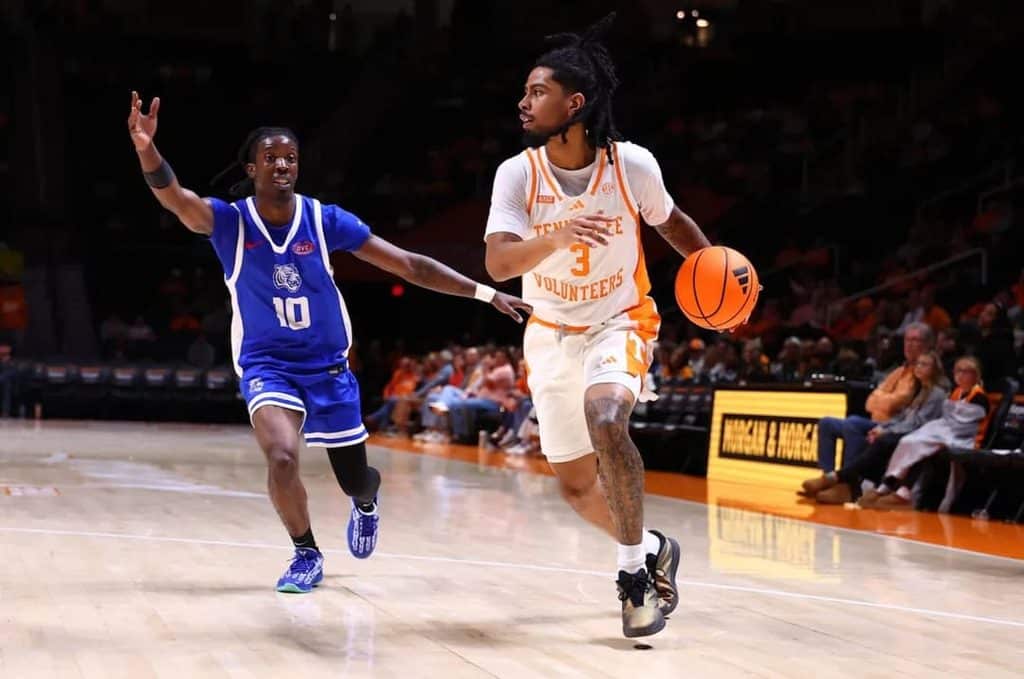
Michigan State travels to Knoxville for a 9 p.m. ET contest against Tennessee, with both programs seeking a statement victory.
The Spartans enter 4-0 and already possess one of the more impressive early-season results: a 79-73 victory over Duke.
That result gives Michigan State a credible measuring point against national-level competition. Tennessee has also started strongly at 3-0, but its early schedule has not presented a comparable regular-season challenge.
Michigan State’s offensive organization begins with Jeremy Fears Jr.
According to the Spartans official game information, Fears enters Tuesday averaging 16.8 points and 10.0 assists per game. His playmaking gives Michigan State a reliable way to generate quality shots without relying exclusively on isolation offense.
The Spartans are averaging 93.0 points and shooting 42.3% from three-point range through four contests.
Those figures are promising, but four games are not enough to establish that such shooting efficiency is sustainable throughout the season.
Tennessee provides a potentially demanding defensive test.
The Volunteers official game center identifies Terrence Hill Jr. as the team’s leading scorer at 18.0 points per game, while DeWayne Brown II leads the team with 10.0 rebounds per contest.
The Volunteers have allowed 61.3 points per game, although the opposition they have faced must be considered before treating that number as evidence of elite defensive performance.
Michigan State brings considerably greater offensive organization and experience against highly ranked competition than Tennessee’s previous regular-season opponents.
The question is whether the Spartans can sustain their offensive rhythm against Rick Barnes’ defense on the road.
The Rebounding Battle Could Determine the Michigan State-Tennessee Outcome
For all the attention placed on guard play, the most important matchup in Knoxville could occur around the basket.
Michigan State has collected approximately 14 offensive rebounds per game through its first four contests. Tennessee, meanwhile, has allowed opponents to grab approximately 17.3 offensive rebounds per game over its first three.
That creates a potentially significant clash.
If the Volunteers surrender repeated offensive boards, Michigan State can extend possessions and make Tennessee defend for longer stretches. Those extra opportunities become particularly dangerous when the Spartans are generating efficient perimeter offense.
Coach Rick Barnes has already expressed frustration with his team’s defensive rebounding and effort during its unbeaten start.
His concerns are understandable. Tennessee has allowed opponents to recover numerous missed shots despite holding them to a low overall field-goal percentage.
Against Michigan State, second-chance possessions could be the difference between controlling the game and spending extended periods defending.
The opposite matchup also matters.
Michigan State has committed approximately 24 personal fouls per game, while Tennessee has attempted 26.3 free throws per contest.
Those early numbers suggest a path for Tennessee to offset Michigan State’s perimeter production by attacking the basket and drawing fouls.
Neither statistical trend should be treated as permanent. The sample sizes remain small, and opponent quality has varied.
Nevertheless, rebounding and foul discipline offer stronger analytical foundations than simply assuming the unbeaten Spartans will continue winning.
What Should Bettors Watch Before the November 17 Games?
The early prediction-market prices favor Duke and Michigan State, but identifying the likely winner is only one part of evaluating a wager.
For Illinois-Duke, the eventual spread needs to account for Duke’s home advantage, Illinois’ offensive potential and the impact of missing frontcourt players. A large line would demand sustained execution from the Blue Devils, not simply a victory.
The total also deserves careful evaluation. Both programs have demonstrated scoring potential, yet their toughest recent games produced more difficult offensive possessions than their early blowouts.
Michigan State-Tennessee presents a different problem.
Michigan State owns the more impressive early victory, but Tennessee’s home court, defensive physicality and potential free-throw advantage could narrow the difference between the teams.
Bettors should monitor the opening spread, any subsequent movement, confirmed player availability and the prices offered across sportsbooks. A market favorite does not automatically represent a worthwhile wager.
These two contests will provide useful evidence about how four potential NCAA Tournament contenders perform under meaningful pressure.
Illinois wants to demonstrate that its scoring talent can overcome defensive resistance. Duke needs to show it can control an elite matchup after its loss to Michigan State. Tennessee must establish greater discipline on the glass, while Michigan State has an opportunity to prove its early success travels.
The most valuable information from Tuesday’s games may not be the final margins alone. It will be which teams consistently create the kinds of possessions that can support their expectations throughout the season.