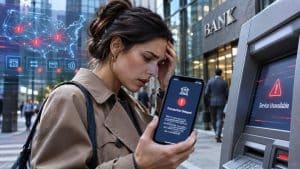
A banking account can have plenty of money in it and still be temporarily unusable. That was the unsettling reality for some Americans on November 16, 2026, when a Chase bank outage disrupted transactions, delayed payments and left customers struggling to access services they normally take for granted.
By Monday evening, JPMorgan Chase said transactions were posting normally again. But the disruption raised a larger concern: when one major bank experiences a technical failure, the effects can reach customers at other financial institutions, even when those banks’ own systems are working.
Chase Bank Outage Was Caused by a Software Bug
JPMorgan Chase identified the problem as a software bug affecting an on-premises hardware system.
The bank said the disruption was not related to a cyberattack and described the incident as isolated to its own systems, although transactions involving other financial institutions could be delayed.
The November 16 banking disruption affected online banking services and some transactions at physical branches. Customers encountered error messages, experienced delayed transfers and, in some cases, reported difficulty making withdrawals or deposits.
For people trying to pay bills, access cash or transfer money between accounts, the distinction between a software bug and a cyberattack offered little immediate comfort.
The practical problem was the same: essential banking services were temporarily unreliable.
However, this was not a bank failure. Chase did not announce that customer deposits had disappeared or that its financial condition prevented withdrawals.
The problem concerned transaction processing and service availability, not a confirmed loss of customer funds.
Why Other Major Banks Appeared to Be Down
One of the most confusing parts of the incident was the number of financial institutions appearing in outage reports.
Customers mentioned Chase, Wells Fargo, Bank of America, Citigroup, U.S. Bank and other institutions. Zelle users also reported payment problems.
That created the impression that the entire American banking system had stopped functioning.
The available evidence tells a more limited story.
Chase was the source of the confirmed technical problem. Other institutions could experience delayed transactions when they needed to send money to, or receive money from, a Chase account.
The distinction becomes clearer when the publicly reported effects are separated.
| Institution or Service | Reported Situation | Important Distinction |
|---|---|---|
| JPMorgan Chase | Transaction processing, online services and some branch activity were disrupted | Confirmed source of the software problem |
| Bank of America | Some customers reported difficulties | The bank did not report a direct system outage |
| Citigroup | Customers transacting with Chase could experience delays | No confirmed comparable internal failure |
| U.S. Bank | Some Zelle transfers involving other institutions were delayed | Its own systems were reportedly unaffected |
| Wells Fargo | Customers reported transaction difficulties | Reports alone did not establish a bank-wide failure |
| Zelle | Some payments involving affected banks were delayed | Its payment network said it remained operational |
This distinction matters because a failed transaction does not necessarily identify which institution caused the problem.
Modern banking depends on interconnected payment networks. A customer may initiate a transfer through one bank while the transaction requires processing by another.
One technical failure can create several apparent outages, even without multiple independent system failures.
Chase Said Transactions Were Processing Normally Again
By approximately 6:30 p.m. Eastern Time on November 16, Chase said transactions were posting normally.
The banking service recovery update followed hours of complaints involving online access, payments and withdrawals.
Although the broader disruption had largely subsided by November 17, customers should not assume every transaction submitted during the outage was completed successfully.
A payment may have been delayed, rejected or processed after its expected time.
That creates a different problem from the original outage.
A customer who sees no immediate confirmation might submit the same transaction again, only to discover that both attempts were eventually processed.
Businesses can encounter similar uncertainty when incoming customer payments or outgoing transfers appear incomplete.
For that reason, transaction verification matters after recovery.
Customers should check their banking activity, pending payments and available balances before attempting another transfer.
What Customers Should Do When Withdrawals or Transfers Fail
The first priority during a banking outage is to establish whether the failure affects account access, an individual transaction or the institution’s wider payment systems.
A banking application that refuses to load does not necessarily mean an ATM, physical branch or telephone banking service is also unavailable.
Customers should contact their financial institution through a verified telephone number or official communication channel.
If a withdrawal fails, confirm whether the transaction was recorded before making another attempt.
If a bill payment appears delayed, verify its status with the bank and the intended recipient. This is especially important for mortgage payments, rent, credit cards and other time-sensitive obligations.
For Zelle transactions, the platform’s payment status guidance advises users to review their payment activity and contact their bank if the status remains unclear.
A pending payment does not always indicate a banking outage; an unenrolled recipient can also cause a transaction to remain pending.
Customers should therefore avoid assuming that every delay shares the same cause.
If an urgent payment cannot be completed, an alternative payment method may be necessary. The customer should first confirm that the original payment will not also be processed.
Failed Payments Can Create Fees and Fraud Risks
A temporary banking disruption can have financial consequences even when customer deposits remain intact.
An automatic bill payment might fail. A delayed transfer could leave insufficient available funds for another transaction. An emergency withdrawal might require using a different ATM that charges fees.
The Consumer Financial Protection Bureau’s banking outage consumer guidance recommends checking automatic payments, exploring alternative ways to access money and asking financial institutions to reverse charges arising from service disruptions.
Customers may request reimbursement for relevant ATM charges, overdraft fees or late-payment costs.
Such reimbursement is not automatic in every situation. Documentation showing the failed transaction, the timing of the outage and any resulting charges can help support a request.
Fraud is another concern.
Criminals can exploit public confusion by sending messages claiming that customers must confirm their credentials, reveal verification codes or move funds to another account.
A legitimate outage announcement should never be treated as a reason to trust unsolicited instructions.
Practical bank account fraud prevention becomes particularly valuable when customers are anxious about accessing their money.
Never transfer funds to a supposed safety account simply because someone claims the banking system is experiencing an emergency.
What the Outage Reveals About America’s Payment Infrastructure
The most significant lesson from the Chase incident is not that banks are suddenly unsafe.
It is that payment systems can be operationally interconnected in ways customers rarely see.
A customer generally experiences banking as a collection of separate applications, cards and accounts. Behind those services are networks of financial institutions, processors and settlement arrangements.
When a major participant experiences a disruption, the customer-facing symptoms can spread beyond the institution where the failure originated.
The November 16 incident also illustrates why it is important to distinguish technical availability from financial solvency.
A software outage can interrupt access to money without indicating that a bank lacks the funds to meet its obligations.
Likewise, deposit insurance addresses eligible losses when an insured institution fails; it is not a guarantee that every banking application or payment service will always remain available.
The practical response is preparation rather than panic.
Customers can maintain another payment option, activate transaction alerts, retain records of important scheduled payments and know how to contact their bank without relying entirely on an application.
The Chase bank outage demonstrated that even familiar financial infrastructure can fail temporarily. Although transactions were reported to be processing normally again by Monday evening, the episode exposed the inconvenience and financial uncertainty that a relatively short disruption can create.
For customers, the lasting lesson is straightforward: having money in the bank and being able to access it immediately are not always the same thing. Knowing how to verify transactions, document problems and use alternative payment methods is an increasingly useful part of everyday financial preparedness.