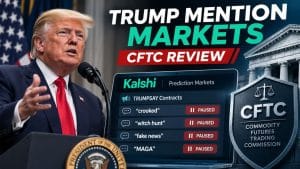
The U.S. Commodity Futures Trading Commission has ordered Kalshi to halt certain prediction markets based on what President Donald Trump might say during public appearances. The November 13 order, reported widely on November 17, raises questions about whether financial contracts tied to a single person’s words can be protected against manipulation and insider trading.
The suspension arrives as the industry faces renewed scrutiny over prediction-market regulation and public trust. Unlike the ongoing dispute between state gambling regulators and federally registered exchanges, this case concerns the federal regulator’s own requirements for approving event contracts. The immediate result is a temporary trading restriction, not a prohibition on prediction markets generally.
Kalshi Trump Mention Markets Face a Federal Review
The CFTC’s November 13 regulatory order covers a specific group of contracts involving President Trump’s remarks. The products include a market asking which nicknames Trump would use before 2027 and a broader series identified as TRUMPSAY.
These contracts allow traders to take positions on whether Trump will say a particular word or phrase before a specified deadline.
A contract resolves in favor of “Yes” when the relevant statement satisfies its rules. Otherwise, it generally resolves in favor of “No,” subject to the contract’s provisions for voiding an outcome.
Kalshi originally submitted the contract series for federal self-certification on February 20, 2025. The exchange later amended its rules concerning multiword phrases in July 2026.
The specific nickname market began trading on October 1.
The CFTC has now stayed the listing of the affected contracts while examining whether Kalshi adequately demonstrated compliance with federal requirements.
The review is not a final finding of wrongdoing.
The regulator is questioning the sufficiency of Kalshi’s certification and has opened a formal proceeding to determine whether that certification was false.
That distinction matters because a regulatory investigation does not automatically establish that a financial product is unlawful.
Why Betting on a Speech Creates a Different Manipulation Risk
Prediction markets can be based on events ranging from election outcomes to financial indicators.
A contract concerning whether a candidate wins an election depends on a process involving millions of voters, election officials and established counting procedures.
A contract concerning whether a president says a particular word presents a different problem.
Its outcome may be influenced directly by one person and known in advance by people involved in preparing the speech.
The CFTC identified this concern in its September 22 mention-market advisory, which addressed contracts based on individuals’ statements, attendance and interactions. The advisory emphasized the need for exchanges to demonstrate safeguards against manipulation.
Consider a hypothetical contract paying $1 if a president uses the word “inflation” during a scheduled speech.
A trader relying on public information can examine earlier speeches, economic conditions and the subject of the event.
But someone with advance access to a prepared transcript may know whether the word is included.
Another person involved in writing the speech might even influence whether the word appears.
That creates an information advantage unavailable to ordinary traders.
The central concern is not simply that political speeches are unpredictable.
It is that the event determining a contract’s payout may be controlled or known in advance by a small group of people.
The CFTC’s review therefore asks whether Kalshi’s contract design and surveillance controls adequately address that risk.
A Previous White House Insider-Trading Case Makes the Concern Concrete
The latest intervention follows an earlier enforcement action involving a former White House employee.
On August 28, 2026, the CFTC announced that Gabriel Perez, who worked as a White House teleprompter operator, had settled charges involving presidential mention contracts.
The CFTC’s enforcement announcement stated that Perez used material, nonpublic information obtained through his employment to trade contracts tied to Trump’s speeches. The regulator found that he improperly used advance access to speech content for his personal financial benefit.
The order required Perez to surrender $107,539.02 in trading profits and pay a $65,000 civil penalty.
Together, those amounts totaled $172,539.02.
The settlement also imposed a three-year trading ban.
The case demonstrates that insider trading is a documented risk, rather than merely a theoretical concern, in this category of prediction market.
However, the enforcement action against Perez should not be confused with a finding that Kalshi itself engaged in insider trading.
The CFTC acknowledged Kalshi’s assistance in the investigation.
That distinction is important when assessing the latest regulatory order, which concerns the exchange’s certification and anti-manipulation obligations rather than an accusation that the platform deliberately profited from Perez’s misconduct.
Kalshi Disagrees With the Suspension
Kalshi has confirmed that it is complying with the regulator’s direction.
The exchange nevertheless disputes the decision.
In Reuters November 17 coverage, CEO Tarek Mansour argued that predicting a president’s statements can provide meaningful information because those statements can influence financial markets.
That argument reflects the potential informational value of event contracts.
Presidential comments about tariffs, interest rates, international conflicts and economic policy can affect investor expectations.
A contract measuring what a president may discuss could therefore reveal how traders interpret an upcoming announcement.
But the existence of informational value does not resolve the regulatory problem.
A market can be useful for some participants while also being vulnerable to traders with privileged access to the event determining its outcome.
The CFTC must assess those concerns under federal derivatives law.
Kalshi has also withdrawn numerous other mention-market offerings during 2026, including sports-related versions.
The latest order is narrower than a general prohibition on contracts involving public statements. Other mention markets remain part of the broader prediction-market landscape.
December 11 Is the Next Important Date
The CFTC has given Kalshi until December 11, 2026, to submit a written response explaining why the certification covering its affected Trump contracts should not be found false.
The deadline establishes the next formal step, not the expected date when trading will necessarily resume.
The regulator will review Kalshi’s response before determining whether the certification was false and what further action, if any, is warranted.
The order also makes clear that the agency has not decided whether all presidential mention contracts are inherently incompatible with federal law.
That leaves open the possibility that particular contract structures and safeguards could satisfy the applicable requirements.
But the burden of demonstrating compliance remains with the registered exchange.
For customers, the immediate concern is understanding which products have been stayed and how existing positions will be handled.
The CFTC order does not establish a universal customer payout or refund arrangement for affected positions. Traders should rely on official exchange communications and their particular contract terms rather than assume how an unsettled position will be resolved.
What the Kalshi Suspension Means for Prediction Markets
The Trump speech-contract dispute reveals an important distinction in the prediction-market industry’s regulatory debate.
Federal recognition of an exchange does not mean every contract it lists automatically satisfies federal law.
The CFTC may defend its jurisdiction over federally registered exchanges while simultaneously examining whether particular products meet anti-manipulation requirements.
Those positions are not inherently contradictory.
One concerns which regulator has authority. The other concerns how that authority is exercised.
The latest action places market integrity above unrestricted product expansion, at least while the affected contracts are under review.
It also creates a practical test for the industry: can exchanges design contracts tied to individual behavior that provide useful information without giving insiders an unacceptable advantage?
The answer could influence future products involving politicians, executives, celebrities and other public figures whose statements can be anticipated or influenced by people working closely with them.
For now, the Kalshi Trump mention markets remain subject to a CFTC stay, and the December 11 response deadline is the next confirmed milestone.
The regulator has not issued a final decision about the legality of the contracts.
What the proceeding establishes is that predicting what a president will say is not only a forecasting question. It is also a question of who knows the answer before everyone else.