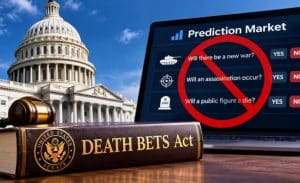
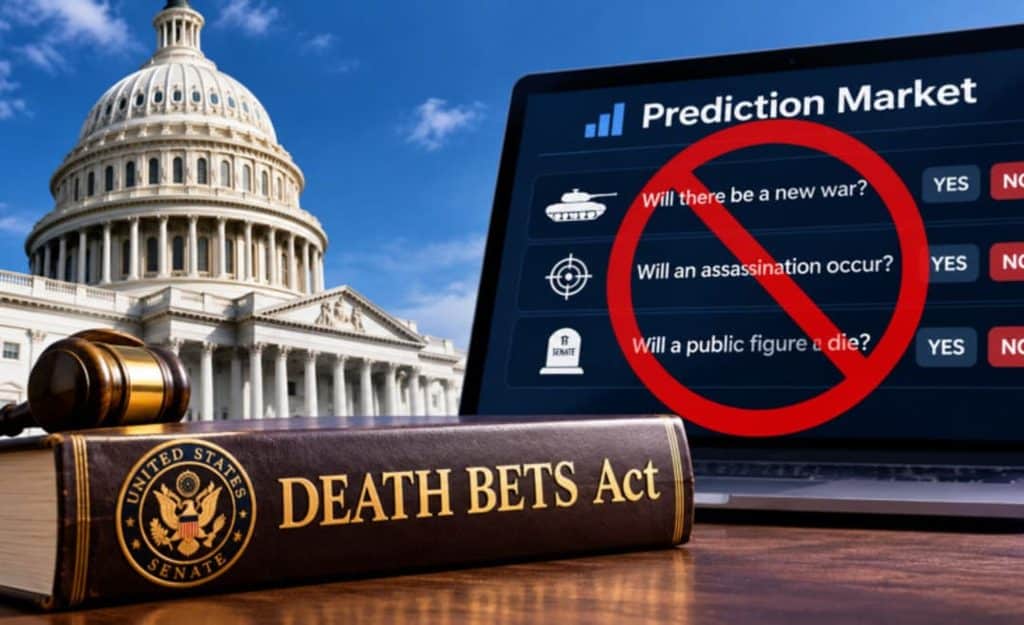
The U.S. Senate has approved legislation that would prohibit federally registered prediction-market exchanges from offering contracts tied to war, terrorism, assassination and an individual’s death. The bipartisan DEATH BETS Act passed on November 19, 2026, marking a significant congressional development in the debate over which events should be traded as financial contracts.
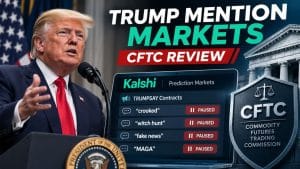
The legislation arrives as federal regulators examine increasingly specialized event contracts. Digital Wager Wire recently covered the CFTC suspension of Kalshi’s Trump speech markets, which raised a different concern involving potential manipulation by people with advance knowledge of public statements. The Senate’s latest action addresses a narrower but more consequential question: whether federally regulated exchanges should be permitted to offer contracts whose outcomes involve violence, military action or death.
DEATH BETS Act Passes the Senate, but Is Not Yet Law
Senators Adam Schiff, a California Democrat, and John Curtis, a Utah Republican, led the legislation, formally titled the Discouraging Exploitative Assassination, Tragedy, and Harm Betting in Event Trading Systems Act.
The Senate approved S. 4035 on November 19 after adopting a bipartisan amendment. The official Congressional Record documents the floor debate, amendment and final passage by voice vote. The measure advanced without a recorded roll-call tally.
That procedure matters because passage by voice vote is not the same as a recorded 100–0 vote.
Senate approval is not enactment. The legislation still requires House approval and presidential action before its proposed restrictions can become federal law.
For prediction-market operators, the immediate development is therefore a change in the legislative landscape, not an automatic shutdown of existing contracts.
What the DEATH BETS Act Would Prohibit
The Senate-passed bill text would amend Section 5c of the Commodity Exchange Act by adding restrictions on certain event contracts offered through federally registered entities. The legislation identifies specific categories rather than attempting to prohibit prediction markets altogether.
| Contract category | Treatment under the Senate bill |
|---|---|
| Terrorism | Contracts expressly referencing terrorism would be prohibited |
| Assassination | Contracts expressly referencing assassination would be prohibited |
| War | Contracts expressly referencing war would be prohibited |
| U.S. military operations | Contracts expressly referencing U.S. Armed Forces military operations would be prohibited |
| Individual death | Contracts expected at listing to resolve principally based on an individual’s death would be prohibited |
| Similar activities | Additional categories could be identified by the CFTC through rulemaking |
The distinction between the first group and the individual-death provision is important.
For war, terrorism, assassination and U.S. military operations, the bill targets covered contracts that expressly reference those subjects.
For death-related contracts, the language focuses on whether an individual’s death is reasonably expected to be the principal event determining the outcome when the contract is listed.
That approach is more specific than a general restriction on every event that could indirectly involve injury or loss of life.
The legislation also gives the CFTC a defined role in determining whether additional similar activities should fall within the prohibition.
Its direct application is to federally registered entities listing or clearing covered contracts. It should not be described as automatically eliminating every offshore or unregistered prediction market.
Why Congress Is Challenging Existing Regulatory Discretion
The United States already has a framework for reviewing event contracts involving sensitive activities.
Under the Commodity Exchange Act, the CFTC has authority to examine contracts involving terrorism, assassination, war, gaming and activities unlawful under federal or state law.
The agency’s June 2026 regulatory proposal described a process for determining whether particular event contracts are contrary to the public interest. That framework involves regulatory review and discretionary decisions.
The DEATH BETS Act would take a different approach for its specified categories.
Rather than leaving the central prohibition dependent on individual public-interest determinations, Congress would establish an express statutory restriction.
That difference matters because a regulator’s policy priorities can change between administrations.
A direct congressional prohibition would establish a legal boundary that an agency could not simply disregard through a different policy interpretation.
Supporters argue that contracts involving death or violence present risks extending beyond ordinary financial speculation.
A participant with advance knowledge of a planned military operation might possess information unavailable to other traders. More seriously, lawmakers have raised concerns that a financial reward tied to violent events could create harmful incentives.
Those arguments explain the legislative proposal. They do not, by themselves, establish that any particular contract caused a violent incident.
The Amendment Protects a Separate Legal Debate
One of the most significant details appears near the end of the legislation.
The Senate added a provision stating that the DEATH BETS Act should not be interpreted as changing the legal permissibility of other event contracts beyond the categories specifically addressed.
This provision has particular significance for sports prediction markets.
Kalshi and other federally regulated platforms have been involved in disputes over whether sports-event contracts fall under federal derivatives regulation or state gambling laws.
Schiff and Curtis have also introduced separate legislation targeting sports betting and casino-style contracts on federally registered exchanges.
But the DEATH BETS Act does not settle those questions.
Curtis explained in his November 20 statement on Senate passage that the amendment was intended to preserve existing legal questions involving other forms of event trading. That includes disputes over state and tribal gambling authority.
The distinction prevents two misleading interpretations.
First, the Senate’s approval does not mean every prediction-market product has been declared unlawful.
Second, the legislation should not be treated as congressional approval of sports contracts simply because it targets other categories.
Sports-market legality remains a separate dispute, governed by existing law and ongoing regulatory and judicial proceedings.
What the Bill Means for Prediction-Market Operators
The proposal creates different considerations for exchanges, traders and regulators.
For federally registered exchanges, the legislation would establish a clearer boundary around contracts involving specified violent events.
Product development teams would need to examine not only whether a contract has a measurable outcome but also whether its subject matter falls within the statutory restrictions.
For regulators, the proposed ban would reduce discretion over the named categories while preserving a role in identifying similar activities through rulemaking.
For traders, the most important distinction is between a contract that is already subject to an existing exchange rule and a contract that could become prohibited if this bill is enacted.
The bill does not itself cancel existing positions.
It also does not establish a general refund or settlement process for customers holding affected contracts.
Any practical consequences for existing positions would depend on the eventual law, applicable regulations and exchange rules.
Platforms would also need to examine contracts whose titles do not explicitly mention violence but whose settlement conditions may nevertheless involve an individual’s death.
That makes careful contract drafting and interpretation central to compliance.
What Happens Next in Washington?
The next legislative step is consideration by the House of Representatives.
The Senate’s approval provides evidence of bipartisan support for restricting these particular contracts. It does not establish that the House will approve identical language or that the measure will reach the president.
The House may consider the Senate bill, pursue its own companion legislation or take no further action before the current congressional session ends.
If lawmakers make substantial changes, additional legislative steps could be necessary before a final measure is presented for signature.
For the prediction-market industry, the immediate task is to distinguish the proposed federal restrictions from existing legal requirements.
Contracts already prohibited under applicable law or exchange rules remain subject to those requirements regardless of the new bill’s status.
The DEATH BETS Act would add an explicit federal statutory prohibition if enacted, rather than replacing the entire regulatory framework for event trading.
A Specific Restriction in a Much Larger Regulatory Fight
The Senate’s November 19 vote represents a meaningful step in federal prediction-market legislation.
Instead of attempting to resolve every dispute over sports betting, political contracts and state gambling authority, lawmakers advanced a measure targeting the relationship between financial speculation and events involving war, assassination, terrorism, military operations and death.
That limited scope is central to understanding the development.
The DEATH BETS Act has passed the Senate, but its restrictions are not yet federal law.
Its eventual significance will depend on whether the House and president approve the measure and how regulators implement its provisions.
For now, the vote establishes a new congressional position on certain event contracts without resolving the broader argument over which prediction markets belong within the American financial system.