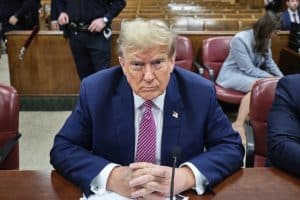
Donald Trump was the 45th president of the United States from 2016 to 2020.
As president, he had the constitutional, legal power to exercise certain privileges. One of those privileges that a president in this country has is the power to grant clemency.
Let’s talk about what granting clemency even means and why we should care.
It turns out that the president’s decisions as to who he should grant clemency toward speak to broader issues about justice that are, for good reason, a hot-button talking point right now. You may want to keep this in mind if you plan on betting on politics this electoral cicle.
What Is Executive Clemency?
As President of the United States, Donald Trump was allowed to intervene in federal criminal cases.
He could pardon a convicted person entirely, which means that one could be convicted in court and then have that conviction effectively wiped out by the president.
Besides pardoning someone entirely, Trump could commute the sentence of a convicted person – he could shorten somebody’s sentence.
Who Benefited From Trump’s Power?
Overall, Trump used his power of granting clemency 237 times. Of these 237 instances, he used his power to pardon 143 times.
Easily more than half of his pardons benefited people with political ties to Trump. For example, five of his political advisers and former members of his campaign staff received clemency. These people were: Paul Manafort, Michael Flynn, Steve Bannon, George Papadopoulos, and the especially controversial Roger Stone.
Why This Matters
It is currently an issue of whether we have real justice in this country. For some people, justice has been reduced to politics.
Right now, as we have a Democrat for President, many conservatives have been complaining that we live by a two-tiered justice system, which isn’t really justice at all.
According to conservatives, one thing that is unfair is that the January 6 protesters received harsh sentences while the Black Lives Matter supporters have been handled lightly. Conservatives point out this disparity to suggest that the mere fact of political affiliation outweighs objective considerations about what is just or fair.
To be sure, they might have a point, however, Trump’s use of executive clemency reveals a double standard among conservatives.
Again, this double standard does not necessarily invalidate the current criticism of conservatives against the justice system in this country. However, it becomes harder to take their complaints seriously. Instead of complaining about objective justice, it seems like they are actually just complaining about their lack of power.
This is because they did not complain about political bias when Trump used his power of executive clemency to help out his supporters. Indeed, Trump often responded to appeals to conservative media and more prominent conservatives. That is, he chose to exercise bias at the prompting of the very people who complain about President Biden and the current DOJ’s political bias.
The Case of Roger Stone
Even Republicans – Mitt Romney is one example – criticized Trump’s commutation of Stone, which prevented Stone from having to serve jail time.
Before receiving his conviction, Stone refused to implicate Trump. He went to jail for, allegedly, covering up for Trump in the context of the Russia election interference scandal that followed Trump’s election victory in 2016. Now, Trump’s commutation of Stone seems like an obvious political move – Trump was, essentially, supporting his supporter.
This is what conservatives allege Biden to be doing when he refuses to prosecute Black Lives Matter protesters. The thing is, it’s not clear what Stone did apart from having a certain political affiliation.
One may say that the whole Russia scandal, now disproven, was a concoction of a sore loser, the woman whom Trump defeated in the 2016 election, that she (Hillary Clinton) designed to use to unseat Trump. According to such logic, as conservatives would have it, Stone should not have been prosecuted.
It follows from this that, yes, Trump was certainly being political. But so were those who tried to put Stone in prison. Jailing Stone would have helped legitimize the Russia narrative that primarily Democrats advanced in order to delegitimize Trump and his election win.
Politics And More Politics
This is complicated, but what we have here is politics upon politics upon politics.
While Trump does not look as bad when we follow the consideration of why Stone was prosecuted, he does seem to be part of a larger problem. He is part of a problem of political bias that precludes actual, objective justice from taking place.
But to be fair to Trump, he is hardly given a choice. If Democrats persecute Stone for their political gain, it is up to Trump to use his political bias to undo the Democrats’ persecution attempt.
In this sense, political bias aids in the attainment of justice. While one’s political bias may happen to impel one to make the objectively correct, just decision, it cannot be said to have a direct connection with justice, however, because objective justice should be defended with logic and reason and it should not be motivated by considerations of politics and friendship.