Key facts
- While the Republican challengers have had several debates, there are none scheduled or planned for the Democrats.
- No incumbent president has faced primary debates since Gerald Ford in 1976.
- Marianne Williamson and Robert Kennedy Jr. (who has since switched to a third party campaign) challenged Biden for the Democratic nomination.
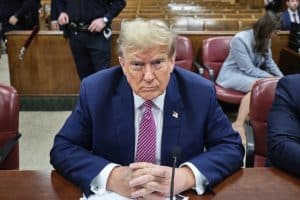
The Republican party held four debates this year as the party sorted through the candidates to challenge President Joe Biden—a Democrat—in 2024. The party’s frontrunner, Donald Trump, however, made news not by what he said or did at those debates, but by sitting them out.
Trump made the choice not to attend after building a large early lead in the polls. He didn’t want to run the risk of anything happening on the debate stage to threaten his lead, leaving his challengers to put on a public spectacle of battling to be number two behind Trump.
On the other side of the political spectrum, the party frontrunner also didn’t participate in primary debates, because the Democratic party chose not to hold any.
Nothing New to Skip Debates
Joe Biden has participated in plenty of debates as a longtime senator, vice-president, and presidential candidate. So the president is certainly capable of stating his case on the debate stage. However, as the sitting president running for reelection, he is the prohibitive favorite to get the party nomination for the presidential race, thus shrinking his chance of failure even on political betting sites.
Over the past 50 years, the incumbent has never had to face primary challengers on a debate stage. Trump, Barack Obama, George W. Bush, and Bill Clinton all ran for reelection without their respective parties holding primary debates. That’s because, for the most part, there were no clear-cut challengers for the party nomination.
The last president to face a strong primary challenge was George H.W. Bush in 1992. Conservative commentator Pat Buchanan ran a campaign for the Republican nomination and had a surprisingly strong performance in the New Hampshire primary to open the race. Bush pulled away, both in New Hampshire and nationally, however, a talk of a debate between the two never seemed to heat up.

In fact, the tradition of incumbents not debating for the party nomination goes back to Gerald Ford, in 1976. As the only U.S. president not to be elected as either a presidential or vice-presidential candidate (after replacing Spiro Agnew as vice president and then assuming the presidency when Richard Nixon resigned), Ford was vulnerable and faced a stiff challenge from Ronald Reagan. There don’t appear to have been any debates between the two candidates, however.
Biden’s Challengers
President Joe Biden is a vulnerable incumbent. Americans have been dissatisfied with inflation and the economy in general, and Biden’s age has been a factor in his low approval ratings and poll performances. There have been whispers within the party that it may be a good idea to run another candidate instead of the president, but most top options in the party pledged their allegiance to Biden and refused to challenge him.
Two candidates did step forward from the fringes to seek the Democratic nomination over Biden—Marianne Williamson, who also ran for the nomination in 2020, and Robert F. Kennedy Jr. Dean Phillips, a member of the House of Representatives, also mounted a challenge.
Both challengers called for the chance to debate the president, but the party steadfastly refused to consider scheduling a showdown. Eventually, Kennedy chose to depart the Democratic party and switched to a third-party campaign in October. Williamson’s and Phillips’ campaigns both continue, but both candidates are polling in single digits, nearly 70 points behind Biden.
Nothing Good Can Happen
Why not debate? There are a number of reasons. First, a former stutterer, Biden has long been notorious for committing gaffes while public speaking. Any foul-ups on the debate stage would add to concerns that his advanced age is impacting his cognitive ability.
Secondly, like Trump, his large lead in the polls gives him no urgency to participate in a debate. The underdogs need a strong performance in the debate to make up ground, but there’s nothing for Biden to gain, while a poor outing can hurt him, both in the Democratic party polls and down the line, when he runs in the general election.
There’s also the issue of legitimacy. Appearing alongside an opponent on the debate stage gives the impression that the candidates are on the same level. Currently, Biden—and Trump—are considered almost done-deal nominees for their parties. There’s no reason to elevate their opposition to their level by deigning to debate. It’s the same strategy Reagan used in 1980 when he financed a Republican primary debate after the party decided not to hold it. While Bush, his top challenger, wanted a one-on-one showdown, he invited all the Republican candidates to attend, essentially demoting Bush by putting him on the same level as all the other minor challengers.
Never Say Never
The 2024 Democratic presidential primary race doesn’t appear to be close enough to merit a debate. That’s not to say that an incumbent will never need to take the stage to face a primary opponent. Essentially, if a challenger is able to outpoll the incumbent in the early months of the campaign, it would likely spur the president into agreeing to schedule a debate.