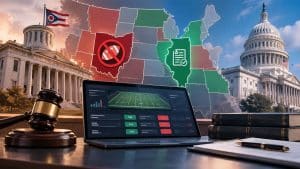
Maryland bill HB 1087 has been sponsored by Del. Pamela Queen, which would effectively ban online gambling on college campuses throughout the state. The bill is now in the House Ways and Means Committee where lawmakers will decide if it will advance to the next stage.
Let’s explore the essential aspects of the bill and assess its implications for the online sportsbooks industry.
Curbing Underage Gambling
The majority of the students on any college campus in America consist of those under 21, the legal minimum age to gamble in Maryland.
Therefore, it’s not surprising that the influx of mobile sports betting that has permeated Maryland since being launched in November 2022 has also made its way to college campuses, with many underage students gaining access through their 21 or over friends.
However, a new bill, HB 1087, introduced by Delegate Pamela Queen, would remedy this problem via her proposed legislation in the following manner:
- Prohibiting online gambling while on campus at an institution of higher education in the state; requiring by Aug. 1, 2024.
- Each institution of higher education to establish a geofence around the perimeter of the campus that prevents access to online gambling within the campus property.
- Each institution of higher education in the state is to publish a written policy online that is consistent with the provisions of the Act.
Therefore, anyone within a college campus – workers, students and faculty alike – would not be able to make an online bet due to a mandated geofence surrounding the perimeter of the college grounds.
The 18–20-year-old age group is particularly susceptible to developing problem gambling patterns, which is the primary reason for the bill. Keith Whyte, Executive Director of the National Council on Problem Gambling, said the following:
“Players within the 18-20 range have the highest rates of gambling participation, the lowest rates in our survey of gambling literacy. They don’t think about budgeting as much. They have all sorts of myths that distorted thinking around their odds of winning.”
The counterargument is that the offshore sportsbooks, many of which are located in unregulated markets and some of whom are predatory in nature, would supplant the U.S.-regulated sportsbooks as a gambling option for those same college-aged students.
This would create an even greater risk to the students without stemming the problem of underage gambling.
Online Casino Bills Introduced
Only six states offer online casino gambling, commonly known as iGaming. However, some Maryland legislators would like to join that select group and one of them is State Rep. Vanessa Atterbeary, who recently introduced HB 1319.
This is the second of two iGaming bills in Maryland’s chambers, with the other coming from State Senator Ron Watson and his SB 603 legislation that he initiated last year. However, it is likely Atterbeary’s bill may hold more sway, as she is the Chairperson of the powerful Ways and Means Committee.
There are similarities between the bills like the cost of an iGaming license being $1 million but the terms vary slightly from Atterbeary’s five years to Watson’s four-year term. The taxes the operators pay under Atterbeary’s bill would be 55% on electronic games and no lower than 20% on live dealer games, while Watson proposes a flat 47% across the board.
John Pappas, state advocacy director with online gaming industry advocacy group iDEA Growth, said, “We are pleased momentum is building and that Chairwoman Atterbeary and Sen. Watson have taken lead roles to shape the policy with an emphasis on job creation and equitable participation. Lawmaking is a process, and I believe that a consensus approach will emerge that benefits consumers, the state, and the industry.”
Both bills are expected to have hearings by the end of the month and Digital Wager Wire will keep our readers updated on any developments as the story unfolds.