The final score says France beat Morocco 2–0. The match said something harsher: Morocco spent nearly an hour keeping the door shut, but they never found a reliable way to leave the room.
That distinction defines this France vs Morocco recap. Morocco’s defensive plan was not foolish, and Yassine Bounou nearly made it look inspired. But bettors following knockout markets through the best U.S. betting sites saw the danger clearly: once France scored, Morocco had no second version of the game available.
The Scoreline Was Respectable, The Match Was Not Balanced
A 2–0 quarterfinal defeat can look competitive from a distance. It sounds like one breakthrough, one late insurance goal, and a brave underdog walking away with its reputation intact.
That was not really this match.
France finished with 22 shots to Morocco’s five, nine attempts on target to Morocco’s one, and an expected-goals advantage of roughly 2.96 to 0.31. Morocco actually held slightly more possession, but that statistic was mostly decorative. France created 19 chances to Morocco’s three and repeatedly reached the dangerous areas that Morocco could not access. The full match-stat breakdown shows how little Morocco’s possession translated into attacking leverage.
That is the first lesson: possession is not control when most of it happens under pressure, far from goal, with no clean final pass waiting.
| Key Signal | France | Morocco | What It Revealed |
|---|---|---|---|
| Total shots | 22 | 5 | France dictated the danger |
| Shots on target | 9 | 1 | Morocco rarely tested Maignan |
| Expected goals | 2.96 | 0.31 | The 2–0 score was deserved |
| Chances created | 19 | 3 | France had repeated routes to goal |
| Possession | 48% | 52% | Morocco’s extra possession lacked threat |
| Goalkeeper saves | 1 | 7 | Bounou prevented a heavier defeat |
The numbers do not say Morocco lacked effort. They say effort was being spent almost entirely on survival.
Morocco’s Plan Worked Until France Asked A Different Question
Morocco’s opening objective was obvious: stay compact, protect the central lane, frustrate Kylian Mbappé and push the match toward the kind of tense final half-hour where favorites start feeling the clock.
For 59 minutes, that plan remained alive.
Bounou saved Mbappé’s first-half penalty, denied other French chances and watched Lucas Digne strike the crossbar before halftime. Morocco reached the break at 0–0 despite producing almost nothing going forward. That felt like success because knockout soccer has trained us to admire survival as strategy.
But survival only works if it creates a platform for something else.
Morocco never reached that next stage. They did not begin winning territory. They did not turn French frustration into counterattacking opportunities. They did not force France’s defenders to retreat or worry about the space behind them.
They were not setting a trap. They were delaying the inevitable.
France’s Counterpress Removed Morocco’s Escape Routes
The biggest tactical failure came after Morocco recovered the ball. France did not allow those recoveries to become attacks.
The first Moroccan pass was pressured. The second was often forced backward or wide. Clearances returned quickly because France’s midfield and defenders were positioned to collect second balls and restart the pressure.
Morocco needed an outlet who could receive with a defender nearby, protect possession and let the team move 20 yards upfield. The injured Ismael Saibari was badly missed because Brahim Díaz, operating as the lone striker, became isolated against France’s center backs.
Morocco coach Mohamed Ouahbi later admitted his team lacked ideas and freshness in possession and that its transitions were not good enough. He also acknowledged that France created the better opportunities and controlled the flanks and central areas.
That diagnosis was accurate. France were comfortable taking risks because Morocco offered so little threat behind the press. Dayot Upamecano and the French defensive line could step forward without feeling that one direct pass would expose them.
A defensive underdog does not need 15 chances. It does need enough attacking credibility to make the favorite hesitate. Morocco never created that hesitation.
Hakimi And The Wide Players Became Full-Time Defenders
Achraf Hakimi is most dangerous when he can turn a defensive moment into a sprinting attack. Against France, he spent too much of the match defending close to his own area.
That was not a failure of effort. It was a consequence of France’s width and movement.
France forced Morocco’s wide players to track runners, close passing lanes and help against Mbappé, Ousmane Dembélé and Michael Olise. Every extra defensive responsibility pulled Morocco’s transition players farther away from the places where a counterattack could begin.
By the time Morocco recovered possession, Hakimi and the supporting attackers were often too deep to threaten immediately. France had time to reset, press again and keep the match inside Morocco’s half.
This was the tactical equivalent of taking away a basketball team’s fast break and asking it to win through half-court creation it does not possess. Morocco’s best offensive weapon was speed into space. France made sure that space barely existed.
Mbappé’s Goal Broke More Than The Deadlock
Mbappé missed the penalty, but great attackers do not treat one failure like a closing argument.
In the 60th minute, he looked up and curled France into the lead. Six minutes later, Dembélé finished the second, with Mbappé involved again. France had spent an hour applying pressure, then ended the contest in one six-minute burst. Mbappé’s goal was his eighth of the tournament and his 20th in World Cup play.
The first goal destroyed Morocco’s only workable script.
At 0–0, defending deep had purpose. At 1–0, Morocco had to move forward. But a team that had spent 60 minutes without a functioning transition game could not suddenly become a fluid attacking side.
The defensive lines separated. Space appeared. France struck again before Morocco could reorganize emotionally or tactically.
That second goal was not merely insurance. It was proof that Morocco had no Plan B.
Bounou Was Brilliant, Which Was Also The Problem
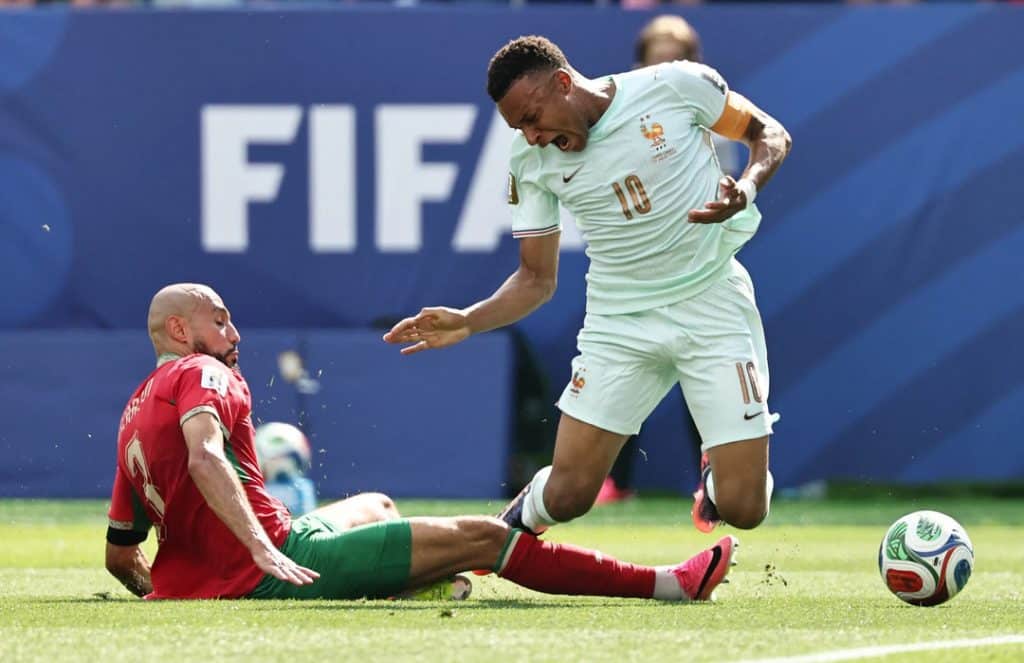
Bounou was Morocco’s best player by a significant margin. He saved the penalty and made seven saves overall, repeatedly keeping France from turning superiority into an early rout.
But when the goalkeeper is producing the heroic performance, the rest of the team is usually losing the larger argument.
Morocco’s defensive structure gave Bounou chances to make saves. It did not protect him from having to make too many of them. Against Mbappé, Dembélé and France’s surrounding talent, that is not sustainable.
Morocco did not register a shot on target until the 84th minute. By then, the match had already been decided and France were managing the closing minutes.
The final judgment is not that Morocco should have attacked recklessly. That would have invited an earlier defeat. The real failure was balance. They defended with purpose but attacked without a mechanism.
France deserved the semifinal because they could win the match in several ways. Morocco had one path: keep the score at zero and hope anxiety did the rest.
This France vs Morocco recap ultimately comes down to that imbalance. Bounou extended Morocco’s resistance, but France’s counterpress removed the outlet, Mbappé broke the block and Dembélé punished the space that followed. Morocco’s structure survived for an hour. Their lack of a second identity ensured it could not survive the night.