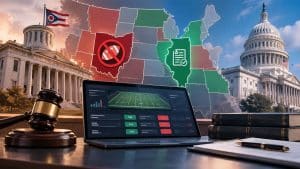
West Virginia State Representatives Roger Hanshaw and Shawn Fluharty have brought a bill before the House to require online gaming operators in the state to share data with academic institutions to study responsible and problem gambling.
Let’s explore the primary concerns within the state and examine the role that top-rated online sportsbooks would assume in this initiative.
Data Download
House Bill 5668, also known as the Responsible Gaming and Research Act, would require that all gaming operators in the Mountain State share their data with West Virginia University to study the effects of gaming gleaned from customer data.
The metrics fed into the report would be anonymous and no customer identities would be disclosed.
The reports would be issued by the platform providers on a monthly, quarterly, or annual basis to include (according to the bill): “all transactional data and metrics related to their mobile gaming operations conducted in the state for the purpose of conducting research to assist the Department of Human Services, State Lottery Commission, or a successor agency or agencies, in ensuring the integrity of gaming or to improve state-funded services related to, or general understanding of, responsible gambling, and problem gambling.”
Beginning on January 1, 2026, and annually thereafter, a report generated by the Department of Human Services in conjunction with the State Lottery Commission shall disseminate the findings of all forms of gaming within the state, including iGaming, sports betting, horse racing, iLottery and retail casino gambling and the impact each has on problem gamblers and addiction.
The Responsible Gaming and Research Act would serve as a blueprint for other states considering iGaming legislation. Representative Fluharty is also the president of the National Council of Legislators from Gaming States (NCLGS), which is another organization working on a standard iGaming pattern for other states to follow.
The 2024 legislative session is more than halfway through, which could pose a problem for this bill to be thoroughly heard, vetted and subsequently overcome any obstacles before being passed by the legislators.
West Virginia Self-Exclusion
West Virginia is no different than every other state that offers gambling to the public in that there are self-exclusion triggers available for those who believe they have a gambling problem.
Below are highlights of West Virginia’s voluntary self-exclusion procedures:
- Registration requires notarized documents and a detailed physical description.
- Offers indefinite exclusion until a removal request after one year.
- Encompasses online gambling, including online partners.
- Emphasizes severe consequences, with violators facing criminal charges and no right to appeal.
Unlike other states, West Virginia does not allow the gambler to choose a time frame for their self-exclusion. Upon acceptance of the request, the bettor will be banned from all casinos and racetracks across the state until they ask to be removed from the list with a minimum one-year waiting period.
Online casino and sportsbook accounts do not have to be deleted after placing one’s self on the self-exclusion list, as those companies will be notified and will not permit anyone on the list to gamble on their site.