The Ceuta migrant crisis has moved from a border emergency into a political test for Spain, Morocco and the European Union. What began as a desperate rush toward a small Spanish enclave in North Africa is now forcing Madrid to balance security, humanitarian duty and a growing backlash across Europe.
The timing makes the story even sharper. Migration pressure can quickly become a market-moving political issue, especially for readers who track elections, policy shocks and risk sentiment alongside broader political betting interest at the best betting sites.
The Ceuta Migrant Crisis Is Bigger Than One Border Breach
Ceuta is not a symbolic border. It is Spanish territory on the North African coast, surrounded by Morocco and facing the Mediterranean. That geography makes it one of Europe’s most politically sensitive entry points because a crossing there is not simply a local security problem. It immediately becomes a Spain-Morocco issue and an EU border issue.
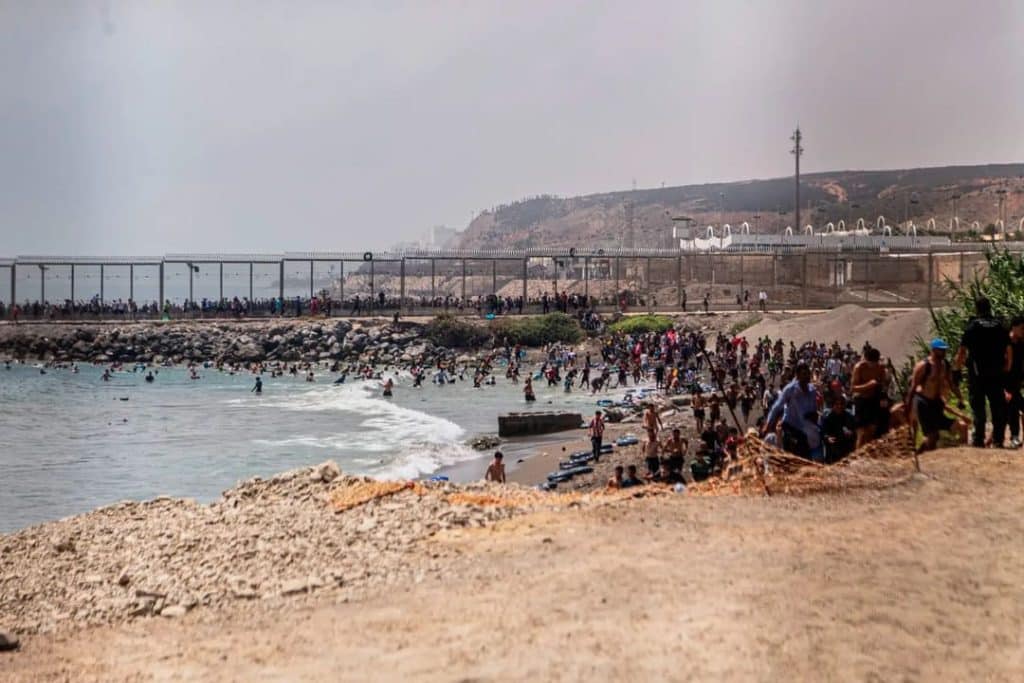
The latest surge has placed that reality under harsh pressure. Spain’s Interior Ministry estimated that roughly 49,000 people crossed into Ceuta over a 24-hour period, a staggering figure for an enclave with limited space, limited reception capacity and a long history of migration flashpoints. That scale has made the crisis impossible for Madrid to treat as routine border enforcement, especially after the 49,000-crossing estimate turned a regional emergency into international news.
The human cost has deepened the political stakes. Migrants reportedly attempted to enter by swimming, wading, climbing and moving around border barriers, while security forces on both sides tried to regain control. Deaths during the crossing have transformed the story from an enforcement question into a moral and diplomatic crisis.
The pressure point is scale. Spain can manage a border incident. It cannot easily absorb a sudden mass movement without help, coordination and political fallout.
Spain Has to Enforce the Border Without Losing the Humanitarian Argument
The hardest part for Spain is that both sides of the debate have real facts to point to.
A sovereign state has the right to control its border, especially when a sudden crossing overwhelms police, military support and local services. Ceuta cannot simply become an unregulated passage into Europe. If Madrid appears unable to enforce the line, the political consequences will spread beyond Spain.
But the humanitarian facts do not disappear because the border is under pressure. Many of the people reaching Ceuta are young, exhausted and exposed to dangerous conditions. Some may have valid protection claims. Others may not. The state still has to process people lawfully, provide immediate emergency care and avoid collective punishment.
That is why Spain’s reception challenge matters. The national system includes humanitarian support for vulnerable migrants who arrive by sea or enter through Ceuta and Melilla, and those humanitarian care rules are now being tested under extreme conditions.
The political trap is obvious. If Spain moves too slowly, it looks overwhelmed. If it moves too harshly, it invites legal and human-rights criticism. If it relies too heavily on Morocco, it exposes how dependent European border control has become on non-EU partners.
Morocco’s Role Is the Diplomatic Core of the Crisis
No Ceuta crisis can be understood without Morocco. The enclave’s border is not just a fence or a coastline. It is a diplomatic pressure valve between Rabat and Madrid.
Morocco is expected to stop irregular crossings before they reach Spanish territory. Spain depends on that cooperation. Europe depends on it too. When the flow suddenly increases, the immediate question becomes whether Moroccan enforcement failed, was overwhelmed or became entangled in wider political tensions.
That does not mean every surge is a deliberate act of pressure. Migration movements can be shaped by rumor, smuggling networks, economic desperation, weather, policing gaps and social media. But in Ceuta, even accidental weakness becomes diplomatic leverage because the consequences land instantly on Spanish and European soil.
The result is a tense partnership. Spain needs Morocco’s help. Morocco knows it. Europe wants border stability but also wants Madrid to comply with EU law and humanitarian obligations.
Border control is diplomacy in Ceuta. Every fence breach, police deployment and repatriation decision sends a message beyond the enclave.
Key Takeaways From the Ceuta Surge
The crisis is moving fast, but the main policy signals are already visible.
| Key Takeaway | Why It Matters |
|---|---|
| Ceuta is a small enclave with outsized political importance | Local pressure quickly becomes a Spain-Morocco and EU issue |
| The number of crossings overwhelmed normal systems | Capacity, processing and emergency care are central problems |
| Migrant deaths changed the tone of the story | Enforcement now faces sharper humanitarian scrutiny |
| Morocco’s cooperation is essential | Spain cannot stabilize Ceuta without coordination across the border |
| EU politics are entering the debate | Schengen, border checks and migration rhetoric may intensify |
This is why the Ceuta migrant crisis cannot be reduced to “people crossed illegally.” It is a stress test of the whole system: border enforcement, asylum processing, diplomatic trust and European political restraint.
Europe’s Reaction Could Make the Crisis Harder to Contain
The EU dimension is already visible because Ceuta sits at the edge of the Schengen conversation. Spain’s enclaves have special border realities, and movement from Ceuta into mainland Spain is subject to controls that complicate simple claims about open movement across Europe.
That detail matters because political rhetoric often moves faster than legal reality. When other European governments warn about secondary movement, border pressure or Schengen security, they are speaking not only to Spain but to their own voters. The framework for temporary border checks gives European governments a policy tool, but using that tool can also inflame the politics around migration.
This is where the crisis can become larger than Ceuta. France, Italy and other EU governments are under domestic pressure from voters who want stricter migration control. Spain, meanwhile, has tried to present itself as both firm on illegal entry and less hostile to migration than some neighboring governments.
Those two positions are difficult to hold during a sudden surge.
The EU risk is contagion: not migrant movement alone, but political panic spreading faster than the facts.
Smugglers, Rumors and Legal Confusion Are Part of the Border Fight
Spanish officials have pointed to trafficking networks and confusion over deportation rules as part of the surge. That explanation should not be treated as an excuse for every failure, but it does capture a real border-management problem.
Smugglers thrive when migrants believe a narrow legal or operational window has opened. A rumor about court rulings, amnesty rules or return procedures can move quickly through messaging apps and informal networks. For people already desperate enough to risk the crossing, even uncertain information can feel like a chance.
That creates a brutal cycle. A perceived opening draws more people. A larger crowd overwhelms the border. The chaos makes enforcement harder. The resulting images then fuel political outrage, which can lead to tougher measures and more dangerous crossing attempts.
AP’s Ceuta border context also shows why the enclave has remained a recurring flashpoint rather than a one-time emergency. Geography, law, policing and desperation keep colliding in the same narrow space.
Spain’s next challenge is not only to reduce crossings. It must also reduce the perception that confusion itself is an invitation.
The Next Test Is Whether Spain Can Regain Control Without Escalation
The immediate measure of success will be whether crossings slow, whether reception pressure eases and whether Spain and Morocco can coordinate returns without producing another humanitarian disaster. But the deeper test is political.
If Madrid stabilizes Ceuta quickly, the crisis may become a severe but contained border shock. If it drags on, it could become a broader fight over Spain’s migration policy, Morocco’s leverage and Europe’s willingness to share responsibility.
That means the next signals matter: voluntary returns, confirmed death tolls, treatment of minors, asylum processing capacity, Moroccan enforcement posture, and any move by EU states to harden internal border checks.
The Ceuta migrant crisis now sits at the intersection of law, diplomacy and public fear. Spain can reinforce a border, but it cannot solve the politics of migration with troops alone. The real question is whether Europe treats Ceuta as a shared warning or lets one small enclave carry the weight of a much larger failure.