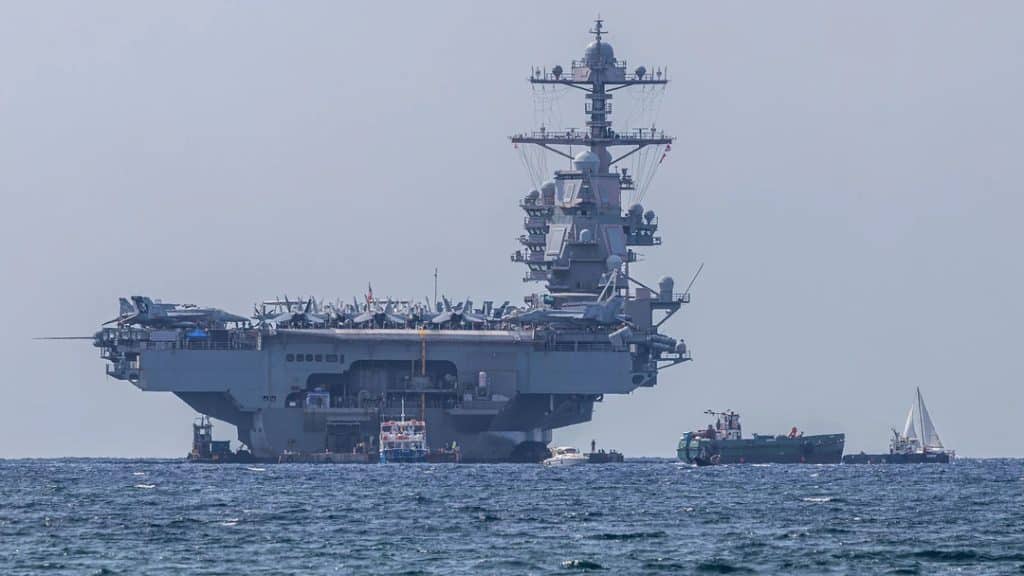
As tensions rise in the Middle East, one name continues to dominate military conversations: the USS Gerald R. Ford. Widely regarded as the most advanced aircraft carrier ever built, this massive warship represents a new era of naval warfare one where technology, firepower, and layered defense systems combine to create a near-impenetrable force.
Now operating in strategically sensitive waters near Iran, the carrier has become both a symbol of deterrence and a focal point in an increasingly volatile region. But what exactly makes this ship so difficult to challenge?
A New Generation of Aircraft Carrier
The USS Gerald R. Ford isn’t just an upgrade it’s a complete redesign of what an aircraft carrier can be. Built to replace older Nimitz-class carriers, it introduces cutting-edge systems that enhance both efficiency and combat capability.
At the heart of the ship is its Electromagnetic Aircraft Launch System (EMALS), which replaces traditional steam catapults. This technology allows aircraft to launch more smoothly and more frequently, increasing sortie rates and operational flexibility.
In practical terms, this means the carrier can deploy more aircraft in less time, giving it a significant advantage in both offensive and defensive scenarios.
Air Power That Dominates the Skies
An aircraft carrier’s true strength lies in its air wing, and the Ford-class carrier delivers in full force. Equipped with a mix of advanced fighter jets, surveillance aircraft, and electronic warfare platforms, it effectively acts as a floating airbase.
These aircraft extend the carrier’s reach far beyond the horizon. They can conduct precision strikes, gather intelligence, and intercept threats long before they get close.
This ability to project power at a distance is one of the key reasons the USS Gerald R. Ford is considered so formidable. Any potential threat must first contend with its air superiority a challenge few can overcome.
Layered Defense: A Multi-Ring Shield
Despite its offensive capabilities, the carrier’s defensive systems are equally impressive. It doesn’t rely on a single layer of protection but instead uses a multi-tiered approach designed to neutralize threats at every stage.
Close-in weapon systems are designed to intercept incoming missiles at the last possible moment, while advanced radar systems detect threats from miles away. Electronic warfare capabilities can disrupt enemy targeting systems, adding another layer of protection.
However, the ship doesn’t operate alone. It is part of a larger Carrier Strike Group, which includes guided missile destroyers, cruisers, and submarines. These accompanying vessels create an expanded defensive perimeter, making it extremely difficult for any threat to get close.
The Role of Advanced Radar and Sensors
One of the most critical advantages of the USS Gerald R. Ford is its state-of-the-art radar system. Unlike older systems, it can track multiple targets simultaneously with exceptional accuracy.
This allows the carrier and its escort ships to respond to threats in real time. Whether it’s incoming missiles, aircraft, or smaller vessels, the system provides early warning and precise targeting information.
In contested waters, where reaction time is crucial, this technological edge can make all the difference.
Iran’s Strategy vs Reality
Iran has long emphasized its ability to challenge large naval vessels using asymmetric tactics. These include fast attack boats, anti-ship missiles, and drones designed to overwhelm defenses.
While these strategies pose a theoretical threat, the reality is far more complex. The layered defenses of the USS Gerald R. Ford and its strike group are specifically designed to counter such tactics.
Missiles can be intercepted at multiple stages, drones can be neutralized through electronic warfare, and fast-moving boats can be engaged before they get within striking distance.
This doesn’t mean the risk is zero, but it significantly reduces the likelihood of a successful attack.
Strategic Importance in Contested Waters
The presence of the USS Gerald R. Ford near Iran is not just about military strength it’s about signaling. Deploying such a powerful asset sends a clear message about readiness and deterrence.
In regions like the Strait of Hormuz, where global energy supplies and shipping routes are at stake, maintaining stability is critical. The carrier’s presence helps ensure that these waterways remain open and secure.
At the same time, it acts as a reminder of the technological and operational gap between the U.S. Navy and potential adversaries.
A Floating Fortress with Global Reach
What sets the USS Gerald R. Ford apart is its ability to operate independently for extended periods. Powered by nuclear reactors, it can remain at sea for years without refueling, limited only by supplies for its crew.
This endurance allows it to respond quickly to emerging threats anywhere in the world. Combined with its advanced systems and powerful air wing, it becomes a self-sustaining force capable of handling a wide range of scenarios.
In many ways, it’s less of a ship and more of a mobile military ecosystem.
Why “Nearly Untouchable” Isn’t an Exaggeration
Describing the USS Gerald R. Ford as “nearly untouchable” isn’t just hype it reflects the reality of its design and capabilities. Every aspect of the ship has been engineered to maximize survivability and effectiveness.
From its advanced launch systems to its integrated defenses, the carrier represents the cutting edge of naval technology. When combined with its strike group, it forms one of the most powerful military formations in existence.
Any attempt to target it would require overcoming multiple layers of defense, each designed to counter specific threats.
Final Thoughts
As geopolitical tensions continue to evolve, the USS Gerald R. Ford stands as a clear example of how modern warfare is changing. It’s not just about size or firepower it’s about integration, technology, and adaptability.
Operating near Iran, the carrier highlights the balance between deterrence and readiness. It serves as both a shield and a signal, reinforcing the importance of maintaining stability in one of the world’s most sensitive regions.
In the end, the USS Gerald R. Ford isn’t just a warship it’s a statement. A statement that, in today’s complex security environment, dominance is achieved not just through strength, but through innovation and precision.