I have seen this claim repeated enough times now that it deserves a closer look: 50,000 US Marines are deploying to the Middle East. It is the kind of headline that immediately grabs attention, but it also compresses a far more complicated military story into a phrase that can easily mislead readers.
The truth is not that the United States is sending 50,000 Marines alone into the region. The larger reality is that the American military presence in the Middle East is being reinforced to a level of roughly 50,000 total personnel, and that broader force includes Marines, sailors, Army troops, air assets, and support elements. In other words, the Marine Corps is part of the buildup, but it is not the entire buildup.
That distinction is more than technical wording. It changes how we understand Washington’s intentions, the scale of the regional crisis, and the level of escalation now underway. When I look at the current deployment picture, I do not see a single-service surge. I see a wider military posture shift designed to create options, project deterrence, and prepare for a crisis that could widen quickly.
Why the 50,000 Figure Is Being Misunderstood
One of the biggest problems with military reporting in moments of tension is that raw numbers are often detached from the structure behind them. In this case, the figure of about 50,000 US personnel has circulated widely, but many readers have come away with the impression that all of those troops are Marines. That is not the case.
What is actually being described is the approximate size of the overall US military footprint in the region as reinforcements arrive. The Marines are a visible and important part of that force, especially because of their rapid-response role and their deployment aboard amphibious ships. But the total also reflects a much wider network of troops already stationed across the Middle East or newly moving into theater.
That matters because language shapes perception. Saying 50,000 Marines suggests something close to a massive invasion package. Saying 50,000 US troops, including Marines, paints a more accurate picture of a layered military buildup that serves multiple missions at once.
The Role of Marines in the Current Buildup
The reason the Marines have attracted so much attention is understandable. The Marine Corps is often the first branch people associate with sudden international deployments, expeditionary missions, and crisis response. In a tense regional environment, their presence sends a clear message that the United States wants forces that can move fast and operate with flexibility.
The current US Marines deployment in the Middle East appears tied largely to amphibious and rapid-response capabilities. That means these forces are not only there to fight if needed, but also to support evacuations, protect strategic facilities, reinforce vulnerable positions, and respond to sudden escalatory events. Marines are particularly valuable in these situations because they can operate from sea-based platforms and shift quickly as the tactical picture changes.
From my perspective, that is one reason the Marine element has received disproportionate attention compared with other units. Marines symbolize readiness. They suggest immediate action. But in strategic terms, they are working inside a much bigger framework, one that includes Army, Navy, and support forces designed to sustain a prolonged regional posture if needed.
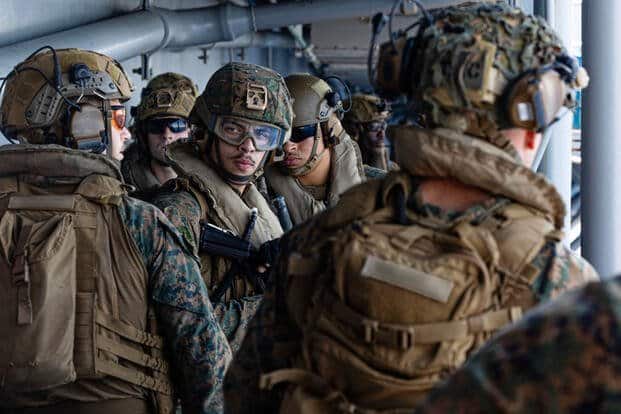
This Is a Joint Force Story, Not a Marine-Only Story
To understand what is happening, I think it helps to step back from the headline and look at the broader force composition. The United States is not just placing Marines in the region and waiting. It is building a joint military presence that can operate across land, sea, and air.
That means the deployment includes sailors supporting naval operations, Army units able to reinforce positions quickly, and the logistical backbone that allows any large overseas force to function. Support troops rarely appear in dramatic headlines, but they are essential. Fuel, transport, communications, munitions movement, intelligence coordination, and medical support all shape what a military presence can actually do.
This is why the regional buildup should be read less as a symbolic gesture and more as a signal of preparation. A mixed force structure gives policymakers more flexibility. It allows Washington to deter attacks, defend shipping lanes, protect bases, reassure allies, and preserve the option of broader military action without publicly committing to one specific path.
Why the Middle East Matters So Much in This Moment
The strategic significance of the region explains why the United States is taking this so seriously. The Middle East is not only a zone of military rivalry; it is also tied directly to global energy routes, commercial shipping, regional alliances, and wider geopolitical stability. Any escalation involving Iran, the Gulf, or nearby strategic waterways can create consequences far beyond the immediate battlefield.
That is why even a moderate reinforcement can carry global importance. A stronger American posture is not simply about troop numbers. It is about deterrence and signal management. Washington wants adversaries to see that it has credible force in place. It also wants allies to see that the region is not being left exposed during a dangerous phase of confrontation.
In practical terms, the buildup suggests concern over several scenarios at once: attacks on US positions, disruption to shipping routes, pressure on partner states, or a broader regional conflict that could force a rapid military response. None of that automatically means war is imminent on a larger scale. But it does mean the Pentagon is preparing for a high-risk environment where reaction time may be short.
A Useful Breakdown of the Situation
| Category | What it likely refers to | Why it matters |
|---|---|---|
| 50,000 figure | Approximate total US military personnel in the region | Shows the broader scale of the buildup |
| Marine component | A smaller share of that total, focused on expeditionary readiness | Supports fast-response and flexible operations |
| Other forces | Army, Navy, air and support elements | Expands deterrence and operational depth |
| Strategic purpose | Force protection, regional stability, contingency planning | Gives Washington military options without immediate escalation |
This is the clearest way to frame the story: the headline number describes the regional force posture, while the Marines represent a highly visible operational slice of that wider picture.
Why Precise Reporting Matters
I think this topic is a good example of why defense reporting requires careful wording. In ordinary conversation, people often use “troops,” “Marines,” and “military” interchangeably. In a crisis, that can create confusion. A Marine Expeditionary Unit does not mean the same thing as a broad regional troop level. A reinforcement mission is not automatically the same thing as an invasion plan.
When coverage becomes imprecise, public understanding suffers. Readers may assume a larger war is already underway, or they may fail to grasp the actual purpose of the deployment. Accurate reporting should not drain the drama from the story. It should sharpen it. In this case, the sharper truth is that the United States is positioning a substantial force in the Middle East to manage uncertainty, project strength, and stay ready for multiple outcomes.
For official regional updates, readers can monitor US Marines deployment in the Middle East through US Central Command, which oversees American military operations in the area.
Final Thoughts
The headline claim about 50,000 US Marines does not fully capture what is happening. What we are really looking at is a wider American military buildup in the Middle East, one that includes Marines but extends well beyond them. The number most likely reflects the total US presence in the region, not a single-branch deployment.
That broader context is the key to understanding the story. The Marines are important because they offer speed, mobility, and visible deterrent power. But the deeper significance lies in the overall force structure now taking shape. To me, that is what makes this development worth watching: not just the number itself, but what that number says about the seriousness of the regional moment, the risks of escalation, and the way the United States is preparing for a conflict environment that remains dangerously fluid.
If you want, I can also make this more news-style, more magazine-style, or more human-written and premium editorial for publishing.